Building for the Long Term: SWGI™ on Google Cloud Marketplace
- Aug 4
- 7 min read

A good system does not merely make action possible - it makes expensive mistakes less likely.
That distinction matters as artificial intelligence, automation, and cloud infrastructure assume more operational responsibility - modern systems can retrieve data, call tools, modify applications, launch workloads, change infrastructure, and initiate transactions at machine speed.
The cost of a poorly governed action is not limited to the action itself - it may include infrastructure consumption, compliance exposure, operational disruption, investigation time, and the consequences of a system changing state before an institution determines whether it had the authority to do so.
That is the problem Axis Systems is addressing with SWGI™.
SWGI™ is now available through Google Cloud Marketplace and the dedicated SWGI on Google Cloud microsite.
Enterprise and public-sector organizations have a direct path to the architecture, examine the execution-authority model, and begin a bounded evaluation.
The value of solving one problem well
Durable businesses are rarely built by trying to own every layer of a customer’s environment.
They are built by finding a critical decision point that existing systems can benefit from.
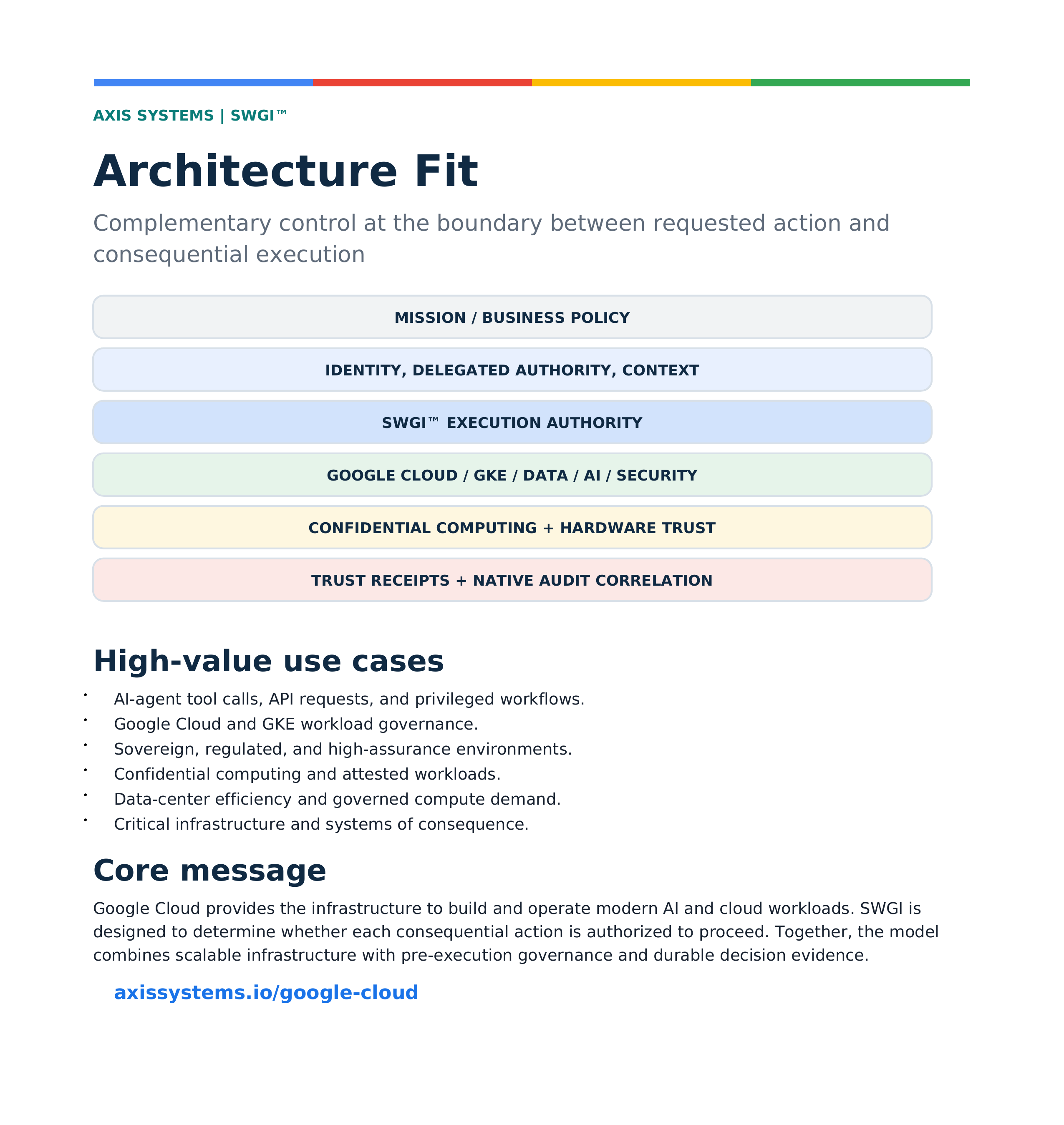
Google Cloud provides the infrastructure, data, artificial intelligence, security, orchestration, and operational capabilities required to build and run modern enterprise systems.
Google Kubernetes Engine provides a managed Kubernetes environment for deploying, managing, and scaling containerized applications and workloads.
Those systems perform essential jobs.
SWGI addresses a different decision:
Should this particular consequential action be permitted to execute now?
SWGI is designed to evaluate the requested action against institutional policy, delegated authority, identity evidence, credentials, purpose, context, target resources, workload conditions, and current system state before execution proceeds.
An authorized action may continue.
An unauthorized action may be blocked before the protected execution path is consumed.
A Trust Receipt can preserve evidence of the resulting decision.
The objective is not to replace identity, Kubernetes, cloud security, policy engines, confidential computing, monitoring, or audit systems.
It is to add a distinct decision at the point where intent becomes consequence.
Access and authority are different economic decisions
A company may give an employee access to a financial system without authorizing every possible transaction.
A government agency may permit a workload to operate inside an approved environment without authorizing every action that workload could technically perform.
A trusted AI agent may possess valid credentials without having unlimited authority over every tool, data source, or downstream system available to it.
This is not an argument against identity or access controls.
It is an argument for precision.
Identity establishes who or what is acting.
Permissions establish a broad access boundary.
Infrastructure controls protect the operating environment.
Monitoring records activity.
Execution governance determines whether the specific action should proceed under the current conditions.
The difference becomes more important as software moves from recommending action to performing it.
Axis has examined that broader transition in Governing the Agentic Internet, which considers the roles of identity, delegated authority, execution control, verification, and proof as autonomous systems begin operating across organizational boundaries.
The more capable the agent, the more valuable a precise authority boundary becomes.

Authorize, execute, prove
SWGI is built around a simple operating sequence.
Authorize
Evaluate whether the requested action satisfies the institution’s current policy, delegated authority, identity, context, credentials, target-resource, workload-integrity, and system-state requirements.
Execute or block
Permit the authorized action to proceed, or block the request before it creates the prohibited state change.
Prove
Preserve evidence of the decision and correlate it with the relevant infrastructure, security, Kubernetes, and audit records.
This operating model matters because an ordinary log generally shows that an event occurred.
A decision record should show that the event was evaluated before it was permitted.
Trust Receipts™ are designed to provide that stronger evidence object: a policy-bound record connecting the actor, requested action, governing policy, decision, integrity information, and resulting outcome.
The principle is concise:
Authorize → Execute → Prove
The implementation must be equally disciplined.
Public claims concerning signing, verification, retention, export, key management, and independent validation must always match the deployed architecture.
Better Together means clear responsibilities
A useful technology relationship should reduce confusion, not create more.
Google Cloud provides the scalable operating environment.
Institutional leaders define the authority boundary.
SWGI applies the execution-authority decision.
Trust Receipts preserve the evidence.
That division allows the customer to retain the value of its existing infrastructure while adding a focused control where consequential execution occurs.
For AI and platform leaders, that can mean governing tool calls, workload transitions, deployments, and state-changing actions.
For security and risk leaders, it can mean adding a pre-execution decision boundary without replacing identity, security, or observability controls.
For infrastructure leaders, it can mean identifying avoidable execution before resources are consumed.
For sovereign and public-sector leaders, it can mean retaining explicit institutional authority inside capable, distributed, and increasingly automated environments.
The model is complementary by design. Google Cloud supplies the environment required to operate modern workloads; SWGI is designed to determine whether the requested action is authorized to proceed.
Trusted infrastructure and authorized action
Some environments require stronger protection for sensitive data and workloads.
Google Cloud Confidential Computing is designed to protect data while it is being processed and includes capabilities spanning Confidential VMs, Confidential GKE, Confidential Space, Dataflow, Dataproc, and other services.
That helps answer an important question:
Is the workload operating inside an intended trusted environment?
SWGI addresses the next question:
Is the requested action permitted under the institution’s current authority and policy?
A trusted environment does not automatically make every action authorized.
The strongest operating model combines:
environmental integrity;
workload and identity evidence;
explicit action authority;
deterministic enforcement;
durable decision evidence.
Intel technologies may contribute hardware-rooted trust, confidential-computing capabilities, attestation, and CPU infrastructure where the selected deployment requires them.
Axis discusses this broader infrastructure relationship in From Silicon to Agentic Workflows, examining how Intel infrastructure, Google Cloud orchestration, confidential computing, SWGI execution governance, and Trust Receipts can operate as complementary layers.
The important point is not that one layer replaces another.
It is that each layer answers a different question.
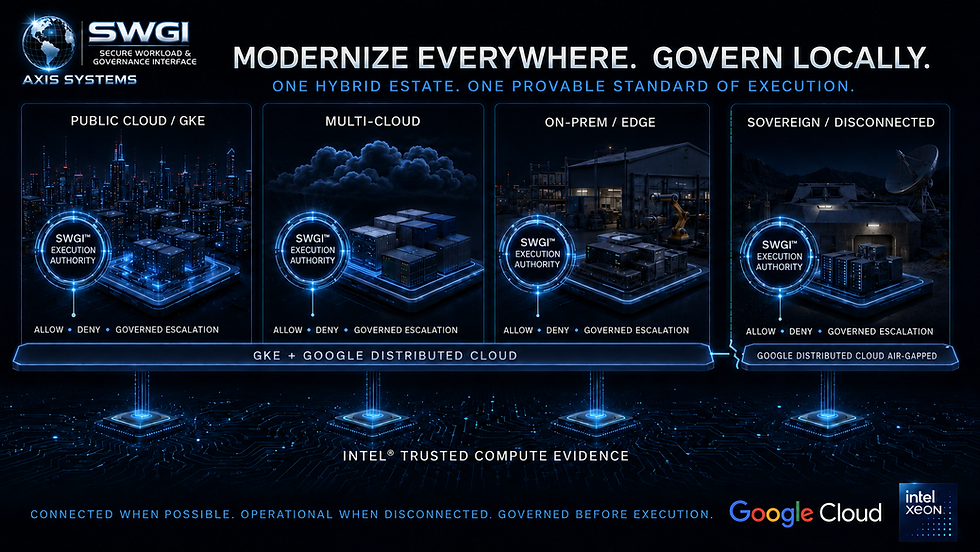
Distributed and sovereign environments
Not every consequential workload operates entirely inside a conventional public-cloud boundary.
Some organizations require local processing, edge deployment, jurisdictional control, disconnected operation, survivability, or reduced latency.
Google Distributed Cloud extends Google Cloud infrastructure and AI capabilities into data centers and edge locations. Its portfolio includes connected and air-gapped models designed for local processing, regulatory requirements, survivability, sovereignty, and low-latency operations.
These environments strengthen the need for clear institutional authority.
The organization may control the location, infrastructure, data boundary, and trusted environment while still requiring an explicit decision about what a workload or AI system is permitted to do.
SWGI is designed for customer-controlled Kubernetes and distributed-infrastructure environments, including GKE, confidential-computing deployments, on-premises systems, edge environments, and other bounded architectures.
The exact enforcement point, data handling, telemetry, evidence, and operational model should be established for the selected Authority Domain.
The economics of acting too late
Governance is often described as a security or compliance concern.
It is also an economic concern.
Every action executed by a modern system consumes something:
CPU or GPU capacity;
memory;
storage;
network resources;
telemetry;
power;
cooling;
engineering attention;
incident-response time.
When the action is authorized and useful, that consumption supports the organization’s mission.
When the action is unauthorized, repetitive, misconfigured, abandoned, or low-value, the infrastructure still carries the cost.
A pre-execution decision can therefore serve two purposes.
It can preserve institutional control.
It can also provide better evidence about which demand should reach the infrastructure at all.
Axis refers to avoidable activity that consumes capacity without producing an authorized business or mission outcome as ghost compute.
The existing SWGI Marketplace article examines the relationship between pre-execution governance, workload demand, power, cooling, telemetry, and effective infrastructure utilization.
The economic case should remain measured.
Axis does not assume that every customer will produce the same recovery percentage, cost reduction, or capacity outcome.
Results depend on:
workload design;
request volume;
policy quality;
traffic patterns;
infrastructure architecture;
existing controls;
baseline demand;
operating conditions.
That is why the commercial path begins with a bounded use case rather than a universal savings claim.
A practical evaluation path
The strongest enterprise technology sale is generally not a broad promise.
It is a bounded proof attached to a consequential workload.
The Axis engagement path begins with an Execution Authority Briefing.
The purpose is to identify one action worth governing and establish:
who or what initiates it;
which policy applies;
who owns the authority boundary;
what identity and contextual evidence must be present;
which target resource is affected;
where the decision should occur;
what happens when authority is missing;
what evidence should remain after the result.
A suitable use case can then progress into an Execution Audit or Authority Validation.
The objective is to determine whether SWGI can:
stop an unauthorized action before execution;
allow authorized activity to continue;
preserve useful decision evidence;
integrate with the selected operating environment;
produce a measurable security, operational, or infrastructure case.
The customer can then decide whether broader deployment is justified.
That is a sounder investment process than committing to a large transformation before proving the control on a real action.
A practical commercial path
Good technology must be understandable, testable, and purchasable.
Google Cloud Marketplace provides a catalog through which customers can discover, try, buy, use, and govern software and services from Google and its partner ecosystem.
It also supports deployment and procurement pathways for SaaS, APIs, VM products, GKE applications, data, AI models, and other solutions.
SWGI’s Marketplace availability gives qualified customers an established route to evaluate the offering within their Google Cloud environment.
The public commercial foundation now includes:
the Better Together solution materials;
the Execution Authority Gap thought-leadership package;
a defined briefing and validation pathway;
and public-sector distribution and quotation support through the Axis Systems Carahsoft page.
Building for the long term
The next generation of trusted infrastructure will not be defined only by how quickly systems can act.
It will also be defined by whether institutions can retain authority over those actions.
Fast systems create value.
Fast systems with unclear authority can create expensive problems faster.
The stronger operating model is disciplined:
Define the authority. Evaluate the action. Permit what should proceed. Block what should not. Preserve evidence of the decision.
That is the model Axis Systems is advancing through SWGI.
Not as a replacement for cloud infrastructure.
Not as a replacement for identity, security, Kubernetes, confidential computing, or monitoring.
As the control responsible for one consequential question:
Is this action authorized to execute now?
Explore the operating model
Review the complete SWGI™ on Google Cloud solution, examine the Trust Receipt evidence model, or access SWGI through Google Cloud Marketplace.
Public-sector organizations can also review the Axis Systems Carahsoft profile.
Bring one consequential action. We will map the authority boundary.


Comments