Modernize Everywhere. Govern Locally: One Execution Standard Across the Hybrid Cloud
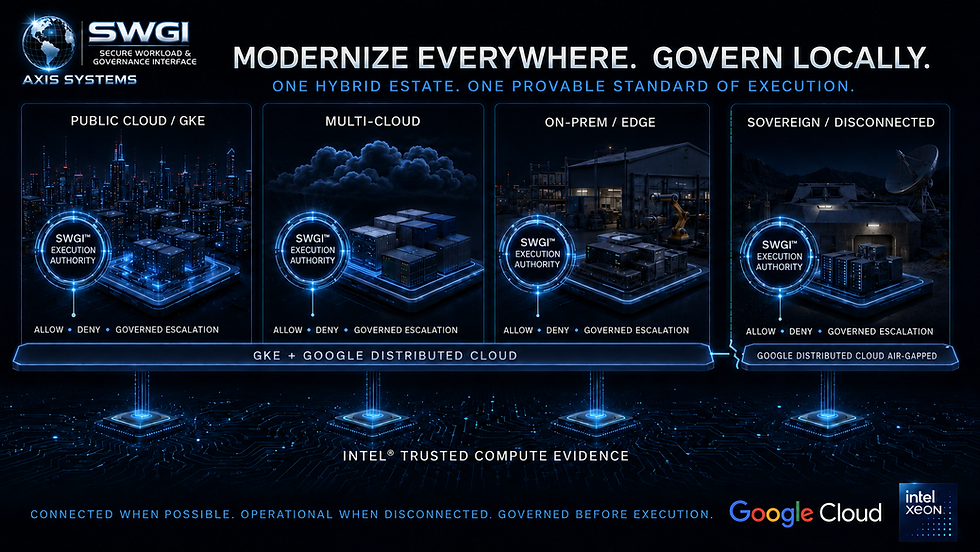
A modern enterprise may operate in public cloud regions, private data centers, Kubernetes clusters, edge facilities, manufacturing environments, and sovereign or disconnected infrastructure - all at the same time.
That is no longer an exception. It is the normal operating model for regulated enterprises, government agencies, critical infrastructure operators and organizations deploying enterprise AI.
The problem is that infrastructure may span environments while governance often remains fragmented.
Each platform can have its own identity system, policy controls, automation framework, observability stack, and operational processes.
Those controls are essential, but they do not always answer the same business-critical question before a consequential action occurs:
Does this specific action have authority to execute right now?
The next generation of hybrid cloud governance requires an efficient, deterministic decision boundary between technical capability and consequential execution.
Hybrid cloud is an operating model - not a temporary transition
For years, hybrid cloud was often described as an intermediate state between an on-premises past and a public-cloud future.
That view no longer reflects reality.
Some workloads belong in public cloud environments because they benefit from elasticity, managed services, and global reach.
Others must remain on-premises because of latency, operational control, data gravity, existing infrastructure, or regulatory requirements.
Edge computing moves processing closer to where data is generated, and decisions are made.
Sovereign and air-gapped environments introduce strict residency, isolation, and continuity requirements. Defense and critical-infrastructure systems may also need to operate under denied, disrupted, intermittent, or limited-bandwidth conditions.
Google Cloud’s own distributed-cloud portfolio reflects this reality.
Google Distributed Cloud includes connected, air-gapped, and software-based deployment models that extend cloud-native and GKE operating patterns into data centers and edge environments.
The infrastructure can be distributed without the organization surrendering a consistent standard of authority.
The governance gap across cloud and on-premises
infrastructure
Identity and access management establishes who or what is requesting access. Network controls determine which systems can communicate.
Kubernetes admission controls govern selected changes to cluster state.
Observability platforms record events and behavior.
These controls remain foundational.
But technical access does not automatically equal institutional permission.
A valid credential may still request an action outside its delegated authority.
An authenticated AI application may attempt a tool call that conflicts with current policy.
An automation pipeline may initiate a technically valid but contextually inappropriate deployment.
A privileged operator may have access to a system without having authority for every possible action at every moment.
Traditional logs can help reconstruct what happened after execution.
Hybrid cloud governance increasingly needs a way to evaluate authority before selected high-impact work begins.
One standard of execution authority, enforced locally

Axis developed SWGI™ - the Secure Workload Governance Interface - as a deterministic pre-execution authority platform.
SWGI evaluates institutional policy, delegated authority, identity, intent, credentials, operational context, target resources, workload-integrity evidence, and current system state before selected consequential actions execute.
The decision returns one of three outcomes:
ALLOW. DENY. GOVERNED ESCALATION.
This creates a consistent control model across customer-controlled:
Public cloud and Google Kubernetes Engine environments
Multicloud and distributed Kubernetes estates
On-premises data centers and private infrastructure
Edge computing and operational environments
Sovereign and regulated systems
Air-gapped and disconnected infrastructure
Enterprise AI, APIs, automation and privileged workflows
The enforcement and data plane can remain inside or near the protected workload. Protected workload data does not need to move into a shared Axis execution environment.
That distinction is central to the architecture:
One standard of authority can span the estate, while enforcement remains local to the environment where the work operates.
How the posture maps across a hybrid estate
Public cloud and GKE
In public cloud and GKE environments, SWGI can govern selected AI tool calls, service-to-service API requests, deployments, automation commands, and privileged platform changes.
It complements existing identity, Kubernetes, security and observability controls rather than attempting to replace them.
Multicloud
A multicloud estate may distribute applications and data across multiple providers, but the organization should not need a different definition of execution authority for each provider.
A policy-bound governance layer can create greater consistency while respecting the native security and operational controls of each platform.
On-premises and edge
On-premises infrastructure remains essential for manufacturing, healthcare, financial services, critical infrastructure, defense, and other latency-sensitive or highly controlled operations.
SWGI can be positioned beside the governed workload or integrated into an API, automation, or platform-control path.
This keeps the authority decision close to the action and inside the customer-controlled environment.
Sovereign, air-gapped, and disconnected environments
Disconnected infrastructure cannot assume continuous access to a centralized external control service.
The governance model must account for locally available policy, delegated authority, evidence freshness, system state, failure semantics, and durable decision records.
When communications are restored, locally preserved evidence can be synchronized and correlated according to the deployment design.
The operating principle is straightforward:
Connected when possible. Operational when disconnected. Governed before execution.
Trusted Infrastructure strengthens context - SWGI determines authority
Trusted-compute and confidential-computing technologies can help establish where and how a workload is operating.
Applicable Intel® Xeon®, Intel® TDX, Intel® SGX and attestation evidence may provide valuable workload-integrity and trusted-environment signals. Intel documentation, for example, describes mechanisms for generating and verifying attestation evidence for Intel TDX trust domains.
SWGI can evaluate those signals as inputs to the authority decision.
The distinction matters:
Identity establishes who.
Trusted infrastructure helps establish where and how.
SWGI determines whether the action has authority to execute.
Trust Receipts preserve the evidence.
Compliance evidence generated with the decision
Hybrid environments often generate large volumes of logs, alerts, and telemetry. The challenge is not simply collecting more data. It is preserving evidence that explains why an action was authorized, denied, or escalated.
Every governed SWGI action can produce a cryptographic Trust Receipt™ containing policy-linked decision evidence, including:
What action was requested
Which identity or workload initiated it
Which target resource was involved
Which policy and authority were evaluated
Which relevant context and integrity evidence were considered
Which decision was returned
When the decision occurred
How does the decision correlate to the runtime outcome?
This supports a compliance-as-code posture in which evidence is generated with the decision, not reconstructed after an incident.
Logs help show what happened. Trust Receipts help preserve why the action had - or did not have - authority to proceed.
Infrastructure efficiency begins before unnecessary work runs
Execution governance can also support a secondary infrastructure-efficiency objective.
Unauthorized, stale, repetitive, misaligned, or policy-invalid work can consume CPU or GPU cycles, memory, network capacity, telemetry pipelines, storage, power, and cooling before the organization determines that the work should not have occurred.
Denying or escalating mapped policy-invalid execution before it runs can help prevent unnecessary activity from becoming infrastructure demand.
A proper validation should establish representative workloads, decision classes, policy complexity, latency, throughput, and resource-impact measurements.
No universal savings percentage applies across every environment.
SWGI’s decision path is designed for sub-millisecond timeframes, with representative performance evidence established for the specific deployment configuration.
Start with one consequential workflow
Organizations do not need to redesign their entire hybrid estate to evaluate this model.
A practical starting point is one bounded workflow where technical access must remain subordinate to institutional authority.
Examples include:
An enterprise AI application requesting a state-changing tool call
A privileged Kubernetes deployment or configuration action
An API initiating a high-impact financial or operational transaction
An autonomous system requesting permission to act on telemetry
An edge workload operating through changing connectivity conditions
An automated production workflow affecting physical operations
A focused Authority Validation can define the action boundary, connect the required identity and policy inputs, test ALLOW, DENY, and GOVERNED ESCALATION behavior, measure decision latency, generate Trust Receipts, and document the path to production.
The result should be an evidence-based deployment decision, not an open-ended experiment.
Modernize everywhere. Govern locally.
Hybrid cloud strategy is no longer only about where workloads run.
It is also about how organizations preserve authority, accountability and operational continuity across a fragmented infrastructure estate.
Public cloud extends reach. Kubernetes creates operational consistency.
Distributed infrastructure brings cloud-native capabilities into data centers, edge locations and disconnected environments.
Trusted-compute evidence strengthens confidence in the operating environment.
SWGI governs the execution.
The objective is not to replace existing cloud, identity, Kubernetes, security or observability investments.
It adds a Deterministic Authority boundary before selected consequential work proceeds.
One hybrid estate. One provable standard of execution.


Comments