Trust Receipts™: Turning Execution Decisions Into Compliance Evidence
Why secure AI infrastructure must move beyond monitoring and prove why execution was allowed.

Secure infrastructure can tell you what happened.
But in high-assurance environments, that is no longer enough.
As AI workloads, autonomous agents, Kubernetes environments, cloud services, privileged operations, confidential computing systems, and data centers become more automated, organizations need stronger evidence around execution itself.
Not just:
What ran?
But:
Why was it allowed to run?
Who or what requested it?
Which policy governed the decision?
Was the action allowed or denied?
Was the outcome preserved as verifiable evidence?
That is the problem Trust Receipts™ are designed to address.
Trust Receipts™ are not simply another log format.
They represent a stronger evidence model for execution governance: a cryptographically verifiable record that an execution request was evaluated, authorized, denied, and tied to a specific policy, identity, workload, action, and outcome.
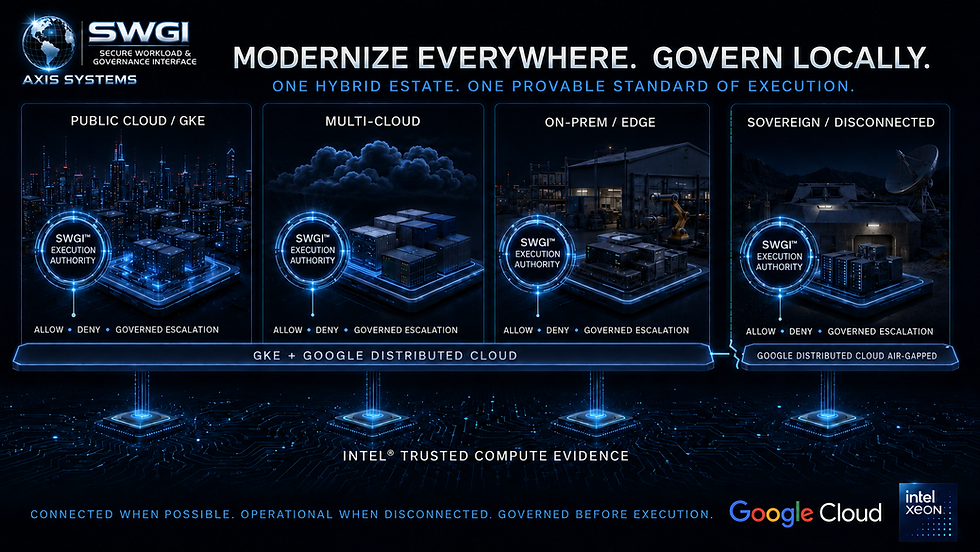
For Axis Systems, this is central to the SWGI™ execution-governance model.
If execution is becoming more automated, more autonomous, and more consequential, then execution decisions need proof.
The Problem: Logs Are Not Proof
Most organizations already have logs.
Cloud logs. Security logs. Kubernetes audit logs. Identity logs. Runtime telemetry. SIEM records. Compliance reports.
Those tools matter. They help teams investigate incidents, monitor systems, review activity, and reconstruct what happened after the fact.
But logs usually answer a retrospective question:
What occurred?
They do not always answer the governance question:
Was this execution authorized before it happened?
That distinction matters.
A workload can run inside an approved environment and still be misconfigured.
An AI agent can operate with valid credentials and still take an unauthorized action.
A Kubernetes workload can pass through a deployment flow and still create audit exposure.
A privileged operation can be logged and still lack clear evidence showing which policy allowed it.
A hardware-attested workload can run inside a trusted environment and still act outside its authorized scope.
That creates a gap between activity visibility and execution accountability.
Trust Receipts™ are designed to close that gap.
The Missing Evidence Object
Modern infrastructure already produces fragments of evidence.
Kubernetes audit events can show request activity.
Cloud audit logs can show resource-level operations.
Binary Authorization can help enforce deployment policies based on signed attestations.
SLSA and in-toto can provide software supply-chain provenance.
Confidential computing attestation can provide trust claims for hardware and workloads.
Transparency logs can create tamper-evident proof of signed statements.
SIEM and SOAR platforms can normalize alerts and support investigations.
Each of these matters.
But they are usually separate evidence streams.
The problem is not that enterprises lack data.
The problem is that the evidence is fragmented.
A security team may need one system to understand who made the request, another to understand what artifact was deployed, another to confirm runtime activity, another to confirm policy, and another to support compliance reporting.
Trust Receipts™ create a cleaner model.
They become the execution-level evidence object that ties the decision together.
A Trust Receipt™ should answer:
This execution request was evaluated.
This identity or workload requested it.
This policy governed it.
This decision was made.
This action was authorized or denied.
This result was correlated to the runtime outcome.
This evidence can be verified later.
That is the shift from fragmented logs to policy-bound execution evidence.
What a Trust Receipt Is
A practical definition:
A Trust Receipt™ is a signed, tamper-evident record proving that an execution request was evaluated against a named policy and identity context, produced a specific authorization decision, and was correlated to a runtime outcome.
That matters because the receipt is not just a record of activity.
It is a record of governed execution.
A strong Trust Receipt™ should identify the specific workload, artifact, action, agent, or control request. It should bind the decision to a named policy, rule, and version. It should connect the decision to the human, workload, service account, device, agent, or system identity behind the request.
It should also prove when the decision was made, preserve the decision in a signed, tamper-evident form, correlate the authorization decision with the runtime outcome, minimize unnecessary sensitive data, and remain retrievable as audit evidence over time.
That is what separates a Trust Receipt™ from a standard log.
A log says something happened.
A Trust Receipt™ says execution was governed.
The SWGI™ Role
SWGI™ is designed around deterministic execution governance.
The core idea is direct:
Execution should not be assumed.
Execution should be evaluated.
SWGI™ validates authority before action, enforces policy before execution, and can generate Trust Receipts™ after authorized or denied decisions.
That means SWGI™ is not positioned as a traditional observability platform.
It is an execution-governance layer.
The platform’s role is to sit closer to the decision point:
Before compute is consumed.
Before state changes occur.
Before autonomous systems act.
Before privileged operations proceed.
Before AI agents trigger high-impact workflows.
Before hardware-rooted workloads create operational consequences.
Before data center resources are consumed by unauthorized or unnecessary execution.
Trust Receipts™ become the proof that the decision was governed.
This supports the Axis Systems model:
Authorize. Execute. Prove.
Why This Matters for AI Agents
AI agents are changing the execution problem.
Traditional software usually follows predefined application logic. Agentic systems are different. They can reason, call tools, invoke APIs, summarize data, trigger workflows, escalate issues, generate tickets, modify configurations, and in some environments, initiate operational action.
That creates a new control question.
It is not enough to know that an agent acted.
Organizations need to know whether the agent was authorized to act.
Was the agent allowed to call that tool?
Was the action inside its permitted scope?
Was the request tied to a valid user, mission, role, or policy?
Was the environment approved?
Was the system state safe?
Was a human approval required?
Was the action denied when conditions were not met?
Was the decision recorded as verifiable evidence?
This is where execution governance becomes essential.
The more AI systems move from recommendation into action, the more organizations need proof that actions were evaluated before execution.
Trust Receipts™ provide that proof layer.
Why This Matters for Kubernetes and Cloud-Native Infrastructure
Kubernetes is becoming one of the main operating environments for modern AI and enterprise workloads.
That makes Kubernetes a natural starting point for Trust Receipts™.
Kubernetes already supports admission control, validating webhooks, policy enforcement, service accounts, workload identity, audit events, and cloud-native lifecycle management.
Those are strong foundations.
But native audit trails and admission decisions are not the same as a signed execution-governance receipt.
A Kubernetes audit event can show activity.
A Trust Receipt™ can show that the activity was evaluated under a specific execution policy before it was allowed or denied.
For cloud-native infrastructure, the Trust Receipt™ model can connect workload identity, namespace and cluster context, image or artifact digest, policy version, admission decision, runtime outcome, cloud audit correlation, SIEM export, and compliance mapping.
That gives platform teams and security teams a cleaner way to prove what happened at the execution boundary.
SWGI™ does not need to replace Kubernetes auditing.
The stronger model is to issue a Trust Receipt™ at decision time, then cross-link that receipt to native Kubernetes and cloud audit records.
That creates a higher-value evidence layer on top of existing infrastructure.
Why This Matters for Hardware, Intel, and Confidential Computing
Cloud-native governance is only one part of the problem.
High-assurance infrastructure also depends on hardware trust.
Confidential computing, trusted execution environments, secure boot, TPM-based attestation, Intel® SGX, Intel® TDX, and hardware-rooted identity all help answer an important question:
Is this workload running in a trusted environment?
That matters.
But trusted hardware alone does not answer the full execution-governance question.
A workload can run inside a confidential or attested environment and still perform an action that was outside policy.
A system can prove that the environment is trusted while still needing to prove that the action was authorized.
A hardware attestation can help validate platform state, but the organization still needs evidence of the execution decision.
That is where Trust Receipts™ extend the hardware trust model.
For Intel-aligned and confidential-computing environments, a Trust Receipt™ can bind execution evidence to Intel® SGX or TDX trust context, TPM or secure boot evidence, hardware model or platform claims, confidential-compute attestation references, workload identity, policy version, execution decision, runtime outcome, and integrity proof.
The point is not to replace hardware attestation.
The point is to connect hardware trust to execution authority.
Confidential computing can prove where and how a workload is protected.
Trust Receipts™ can prove why the workload or action was allowed to execute.
Together, that creates a stronger chain:
Trusted hardware.
Verified workload context.
Policy-authorized execution.
Signed evidence after the decision.
For Intel-only or hardware-first customers, this matters because their buyer logic is different from that of a pure cloud buyer.
They are not only asking whether the workload is observable.
They are asking whether the hardware root of trust, workload state, policy decision, and execution outcome can be connected into one verifiable evidence chain.
Trust Receipts™ give SWGI™ a way to bridge that chain.
Why This Matters for Data Centers and Infrastructure Operations
Trust Receipts™ also matter beyond cybersecurity and compliance.
They matter for data center operations.
Modern data centers are under pressure from AI workloads, GPU demand, cloud expansion, power constraints, cooling limits, telemetry growth, and infrastructure buildout pressure.
In that environment, execution is not just a security event.
Execution becomes an infrastructure demand.
Every unnecessary workload consumes compute.
Every unauthorized action creates risk.
Every misconfigured job can expand telemetry, memory pressure, storage usage, network activity, and operational overhead.
Every uncontrolled AI or automation workflow can create avoidable demand inside already constrained environments.
Data center leaders therefore need more than visibility into utilization.
They need evidence around execution decisions.
Trust Receipts™ can help answer which workloads were authorized to run, which execution requests were denied, which policies created the most denials, which systems generated repeated failed or unauthorized requests, and which AI agents or automated workflows created unusual execution demand.
That matters because execution governance can become part of infrastructure control.
A Trust Receipt™ not only supports audits.
It can also support capacity analysis.
If every governed execution decision produces a signed record, infrastructure teams can begin separating authorized execution from denied execution, repeated execution attempts, policy-violating execution, misconfigured automation, unnecessary workload activity, and capacity pressure tied to specific systems.
Instead of only asking:
How much compute did we use?
Teams can ask:
How much execution was actually authorized?
How much execution was denied before consuming resources?
How much workload activity created avoidable pressure?
This is where Trust Receipts™ connect to the broader Axis Systems thesis around ghost compute, capacity recovery, and infrastructure efficiency.
The future data center will not only need more power, more cooling, more GPUs, and more telemetry.
It will need better execution control.
Trust Receipts™ create the evidence layer for that control.
Why This Matters for Compliance
Compliance teams do not only need more data.
They need evidence that is structured, relevant, durable, and reviewable.
For regulated organizations, Trust Receipts™ can support stronger evidence workflows across NIST control mapping, FedRAMP audit and accountability requirements, RMF and DoD RMF authorization packages, SOC 2 control evidence, continuous monitoring, incident reconstruction, procurement validation, operational assurance, and AI governance reporting.
The important point is this:
Trust Receipts™ do not automatically make an organization compliant.
They improve the quality of compliance evidence.
They give assessors, authorizing officials, CISOs, platform teams, and procurement offices a clearer record of execution decisions.
Instead of searching across disconnected logs to reconstruct what happened, teams can review a signed evidence object tied to policy, identity, subject, decision, and outcome.
That is a better compliance posture.
Not because the receipt replaces controls.
Because the receipt proves a control-mediated decision occurred.
How Trust Receipts™ Are Created and
Verified

Trust Receipt™ Evidence Chain: SWGI™ converts execution requests into signed, policy-bound evidence that proves authorization, outcome, and verification history.
Trust Receipts™ require more than a timestamped event record.
They require a verifiable evidence chain.
At a high level, a Trust Receipt™ can be created through four steps.
First, an execution request is evaluated.
A workload, AI agent, service account, user, device, or automation workflow attempts to act. SWGI™ evaluates that request against identity, policy, environment, workload context, risk conditions, and required evidence.
Second, the decision is generated.
The system returns a deterministic authorization result: allowed or denied. The decision should identify the governing policy, policy version, rule, subject, actor, action, time, and decision rationale.
Third, the receipt is signed.
The receipt payload is hashed and signed using a trusted signing mechanism.
Depending on the environment, this can use formats such as JSON Web Signature, DSSE, CBOR/COSE, or other cryptographic envelope formats designed for verifiable claims and attestations.
Fourth, the receipt is stored and correlated.
The signed receipt is stored in an append-only or tamper-evident repository and cross-linked to native evidence sources such as Kubernetes audit logs, cloud audit logs, CI/CD provenance, confidential compute attestation, SIEM events, or compliance records.
Verification works in reverse.
A verifier should be able to inspect the receipt, validate the signature, confirm the issuer, check the payload hash, verify the policy version, confirm the subject and actor, review the authorization result, and correlate the receipt with downstream runtime evidence.
A strong Trust Receipt™ should therefore support signature verification, payload integrity checks, issuer validation, policy-version validation, timestamp and freshness checks, subject-to-action binding, outcome correlation, offline verification where possible, and exportable evidence for auditors, assessors, and procurement teams.
The goal is not to create more telemetry.
The goal is to create proof.
How Organizations Can Implement Trust Receipts

Trust Receipt™ POC Roadmap: A phased implementation path for proving signed allow/deny receipts, audit correlation, offline verification, and assessor-ready evidence.
Organizations do not need to rebuild their infrastructure to adopt Trust Receipts™.
The practical path is to start at the execution decision point.
For most cloud-native environments, that means beginning with Kubernetes, GKE, OpenShift, CI/CD, identity, and policy enforcement systems.
A practical implementation path looks like this.
First, define the governed execution events.
Start with the actions that matter most: workload deployment, privileged operations, AI agent tool calls, access to sensitive systems, confidential-compute workload launch, policy-sensitive automation, and high-impact infrastructure changes.
Second, establish the policy decision point.
Execution requests should be evaluated through a policy engine or governance layer.
This may connect to existing controls such as IAM, OIDC, Kubernetes admission control, OPA, CEL, workload identity, service accounts, SPIFFE/SPIRE, CI/CD provenance, or confidential-compute attestation.
Third, generate a canonical receipt.
Each governed decision should emit a receipt using a stable schema.
The receipt should capture the subject, actor, action, policy, decision, timestamp, rationale, hash, signature, and correlation references.
Fourth, store receipts in a tamper-evident repository.
Receipts should be stored in an append-only object store, database, ledger-backed store, transparency service, or other tamper-evident evidence repository. High-assurance environments may add external timestamping or transparency-log inclusion proofs.
Fifth, correlate with native infrastructure evidence.
Trust Receipts™ should not replace existing logs. They should reference and strengthen them. A receipt can cross-link to Kubernetes audit IDs, cloud audit logs, build provenance, image signatures, SBOM references, SIEM events, and confidential-compute attestation claims.
Sixth, export evidence for security and compliance workflows.
The receipt should be usable by security teams, compliance teams, auditors, procurement officers, and Authorizing Officials. That means supporting normalized exports into SIEM, SOAR, GRC, OSCAL-aligned evidence packages, or continuous monitoring reports.
The best first implementation is narrow.
Start with one high-value control path:
A Kubernetes admission decision.
A privileged automation workflow.
An AI agent tool call.
A confidential-compute workload launch.
A CI/CD deployment gate.
Then prove that every allowed and denied decision produces a signed, verifiable receipt.
That creates a measurable foundation before expanding across the enterprise.
What a Trust Receipt™ Should Capture

Anatomy of a Trust Receipt™: Each receipt captures the minimum evidence needed to verify who requested execution, what policy governed it, what decision was made, and how the result can be audited.
A strong Trust Receipt™ should be small enough to generate efficiently, but rich enough to support later verification.
At a minimum, it should capture receipt ID, schema version, issuer, execution subject, requested action, actor identity, policy ID, policy version, decision result, decision timestamp, rationale code, outcome correlation, payload hash, signature, and verification reference.
For stronger environments, it may also include references to software provenance, build pipeline evidence, artifact signatures, SBOM references, confidential-compute attestation, Kubernetes audit IDs, cloud audit log IDs, SIEM event IDs, transparency log entries, timestamp authority proofs, and retention classification.
The design principle is important:
Do not overload the receipt.
A Trust Receipt™ should avoid unnecessary raw data, secrets, bearer tokens, personal information, or bulky logs.
The stronger pattern is minimal canonical payload, references to external evidence, cryptographic integrity, privacy minimization, offline verification, and long-term retrievability.
That keeps the receipt useful without turning it into a new risk surface.
Why Denials Need Receipts Too
Trust Receipts™ should not only document allowed execution.
Denied execution matters just as much.
A denial receipt can prove that a risky, unauthorized, misconfigured, or policy-violating action was blocked before execution.
That matters for security investigations, compliance review, policy tuning, insider-risk analysis, AI agent governance, incident prevention, operational accountability, procurement demonstrations, and infrastructure efficiency analysis.
If an AI agent attempts to act outside its permitted scope, the organization should have proof that the action was denied.
If a workload attempts to deploy without required provenance, the organization should have proof of enforcement.
If a privileged operation fails policy validation, the organization should have evidence of the denial decision.
If repeated execution attempts create capacity pressure, infrastructure teams should have a record showing what was blocked and why.
This is where Trust Receipts™ become valuable beyond audit.
They become operational proof that governance is working.
Challenges and Limitations
Trust Receipts™ are powerful, but they must be designed carefully.
The first challenge is latency.
If receipt generation adds too much overhead to the execution path, platform teams will resist it. The right architecture is a minimal inline receipt payload, fast signing, and asynchronous enrichment or transparency logging where needed.
The second challenge is overcollection.
A Trust Receipt™ should not become a dumping ground for raw tokens, secrets, personal data, or excessive runtime telemetry. The stronger model is privacy minimization: store only the necessary claims, hashes, references, and decision metadata.
The third challenge is schema discipline.
If every team creates its own receipt format, the evidence becomes fragmented again. Trust Receipts™ need a stable schema, versioning, field definitions, verifier logic, and export compatibility.
The fourth challenge is key management.
Signed receipts are only as trustworthy as the signing keys and trust roots behind them. Organizations need strong key custody, rotation, revocation, certificate-chain management, and verification procedures.
The fifth challenge is storage and retention.
Execution evidence can grow quickly. Organizations need clear retention classes, storage cost models, search performance requirements, legal hold rules, and deletion controls.
The sixth challenge is correlation quality.
A receipt without links to native audit records, runtime outcomes, policy versions, and evidence sources may be cryptographically valid but operationally weak. The value comes from connecting the decision to the surrounding execution context.
The seventh challenge is auditor and assessor acceptance.
Trust Receipts™ improve evidence quality, but they do not automatically satisfy compliance requirements. Organizations still need control mappings, assessor-facing explanations, verification procedures, and alignment with existing frameworks such as NIST, FedRAMP, RMF, SOC 2, and internal audit programs.
The final challenge is vendor lock-in.
Receipts should be exportable and independently verifiable. A customer should not need a proprietary service just to prove that a historical execution decision was valid.
These limitations do not weaken the Trust Receipt™ model.
They clarify the design standard.
A strong Trust Receipt™ architecture should be fast, minimal, signed, verifiable, exportable, privacy-conscious, correlated, and durable.
That is what turns execution governance from a control claim into compliance evidence.
The Buyer Value
For CISOs, Trust Receipts™ reduce ambiguity around privileged and automated actions. They create a signed record of what was requested, what policy governed it, and what happened next.
For CIOs, Trust Receipts™ create a machine-readable evidence layer across Kubernetes, cloud infrastructure, CI/CD, confidential computing, regulated workloads, and AI systems.
For Authorizing Officials, Trust Receipts™ can support ongoing authorization by providing durable evidence of execution decisions tied to policy and runtime outcomes.
For procurement leaders, Trust Receipts™ make claims measurable. A solicitation can require signed receipts, offline verification, exportable schemas, retention controls, privacy minimization, and control mapping.
For federal and regulated teams, Trust Receipts™ can strengthen continuous monitoring and audit readiness without replacing native logs or existing compliance workflows.
For hardware and confidential-computing buyers, Trust Receipts™ connect platform trust to execution authority. Hardware attestation can help prove that a workload is running in a trusted environment. Trust Receipts™ add proof that the workload or action was authorized under policy before execution.
For data center and infrastructure leaders, Trust Receipts™ create decision-level evidence around workload demand. They help distinguish authorized execution from denied, unnecessary, misconfigured, or policy-violating activity, supporting capacity analysis, ghost compute reduction, and infrastructure efficiency.
For AI governance leaders, Trust Receipts™ provide a record of what agents and automated systems were authorized to do before they acted.
That is why this category matters.
Trust Receipts™ convert execution governance into evidence.
Conclusion
The most secure workload is not only the one that is monitored.
It is the one that was authorized before it was executed.
Trust Receipts™ give organizations a way to preserve that authorization as evidence.
They create a signed, tamper-evident record of the execution decision, the governing policy, the identity context, the subject, the outcome, and the integrity proof.
For Axis Systems, this is one of the clearest expressions of deterministic execution governance.
SWGI™ validates authority before action.
Trust Receipts™ prove the decision after authorization.
Together, SWGI™ and Trust Receipts™ create a bridge between cloud governance, hardware trust, compliance evidence, and data center efficiency.
They support a stronger operating model for AI, cloud, Kubernetes, autonomous systems, confidential computing, public sector, high-assurance infrastructure, and modern data centers.
Secure infrastructure tells you what happened.
Trust Receipts™ prove why execution was allowed.

Comments