Beyond the Hype: 5 Surprising Realities of “True” Zero Trust at Runtime
In the cybersecurity world, “Zero Trust” has become a term so diluted by marketing departments that it is often met with eye-rolls.
For most, it has meant nothing more than a rigorous identity check at the perimeter - a gatekeeper that falls asleep once the user is inside.
This passive approach to security is a relic.
In complex hybrid-cloud environments, checking who someone is at the door isn’t enough; you must control what the system does at every microsecond of execution.
A paradigm shift is emerging in the form of the Secure Workload and Governance Interface (SWGI).
This isn’t another reporting tool that tells you how you were breached three weeks ago.
It is a runtime authority where policy is an active participant in the execution path.
In this model, nothing advances - not a single packet or robotic command - unless a customer-controlled authority explicitly authorizes it in real time.
1. Security That Moves at the Speed of Thought (0.3 Milliseconds)
The most common argument against deep runtime inspection is the “latency tax.”
Architects have long assumed that placing a governance engine in the direct path of execution would inevitably cripple performance.
SWGI shatters this assumption by proving that authorization can be nearly instantaneous.
It is important to distinguish between the core decision and the network overhead.
While total round-trip and persistence are reported separately to maintain architectural honesty, the engine itself operates at a speed that renders it invisible to the end user.
Core policy P99 measured 0.3065 milliseconds.
By achieving a sub-millisecond P99, this runtime authority ensures that mission-critical governance does not become a bottleneck - It allows for high-volume, real-time request processing without the lag typically associated with legacy security gates.
2. The Power of the “Yellow” Path: Keeping AI in Motion

Most security systems are binary: (Allow) or (Deny). This all-or-nothing approach is too blunt for modern AI and autonomous workflows. SWGI introduces a sophisticated middle ground: the Yellow path.
Blue (Allow): Permits the requested action.
Red (Deny): Prevents execution entirely to stop a threat.
Yellow (Modify): Instead of a hard block that breaks the user experience, policy redirects the request into an approved path.
For organizations deploying generative AI, the Yellow path is a game-changer.
It allows for real-time remediation of non-compliant prompts or outputs without interrupting the generation process.
By modifying execution in flight, you maintain security guardrails without the frustration of constant “Access Denied” errors that ruin the utility of the tool.
3. The Kill-Switch Dilemma: Security in Disconnected States

A massive vulnerability in cloud-first security is the “mothership” dependency. If your connection to the central security provider drops, your system faces a lose-lose choice: fail open, risking a breach, or fail closed, risking a total operational shutdown.
True runtime Zero Trust uses Local Autonomy to solve this. When connectivity to the external world is impaired, the customer does not lose control. The local environment continues to function through a Local Autonomy Loop:
Observe the request.
Evaluate the intent.
Decide based on local, cached policy.
Enforce the decision.
Sign the result.
When connectivity returns, the local authority synchronizes its queued evidence with the central command center.
Crucially, the original decisions, hashes, and signatures remain unchanged, providing an immutable record of what happened while the system was off the grid.
4. Receipts, Not Reports: The Evidence Contract
Transparency usually requires a trade-off with privacy.
In traditional systems, auditing a security event often requires exposing the sensitive data that triggered the alert.
SWGI replaces this invasive reporting with a Signed Trust Receipt system.
This creates an evidence contract that provides durable proof of every decision without ever moving the underlying data.
A Signed Trust Receipt binds the following elements into a single cryptographic package:
Workload and Namespace: Identifies the specific origin of the request.
Governing Policy Decision: Records the exact rule that was applied.
Issue Time: Provides a precise, immutable timestamp.
Signature: Supplies cryptographic proof of the customer’s authority.
Enforcement State: Records the final status—Applied, Running, Claimed, or Blocked.
Payload Hash: Creates a unique fingerprint that ensures integrity without revealing content.
This evidence then flows into existing pathways such as Datadog, Splunk, or ConnectWise.
You gain a complete administrative chain of custody - knowing who changed a policy or updated a status - without the data ever leaving your control.
5. Failing “Under” Policy, Not “Around” It
In high-stakes environments such as robotics or edge computing, the baseline is always Default Deny.
Trust is never inherited; it is earned per execution.
The most critical distinction in this architecture is how the system handles failure.
"This is mission-critical governance that fails under policy, not around it."
When a system fails around policy, it bypasses security to keep the lights on, creating a massive window of vulnerability.
When it fails under policy, the security parameters remain the governing force even during a failure state.
This ensures that even in degraded modes or during a partial system collapse, the environment never operates outside the customer’s defined authority.
The Privacy Boundary: What Stays and What Goes
For organizations managing a footprint across private infrastructure and public clouds- including Kubernetes, Amazon EKS, Google GKE, Microsoft AKS, and Red Hat OpenShift—the privacy boundary is the most significant hurdle.
SWGI solves this by creating a hard physical and logical divide.
What Stays Local: Customer payloads, model data, secrets, and encryption keys never leave the customer-controlled environment. They stay behind your firewall, on your edge device, or in your private cluster.
What Leaves the Boundary: Only signed operational metadata. This metadata is used for auditing, billing, and marketplace metering, turning governed actions into a clear usage count without exposing the substance of those actions.
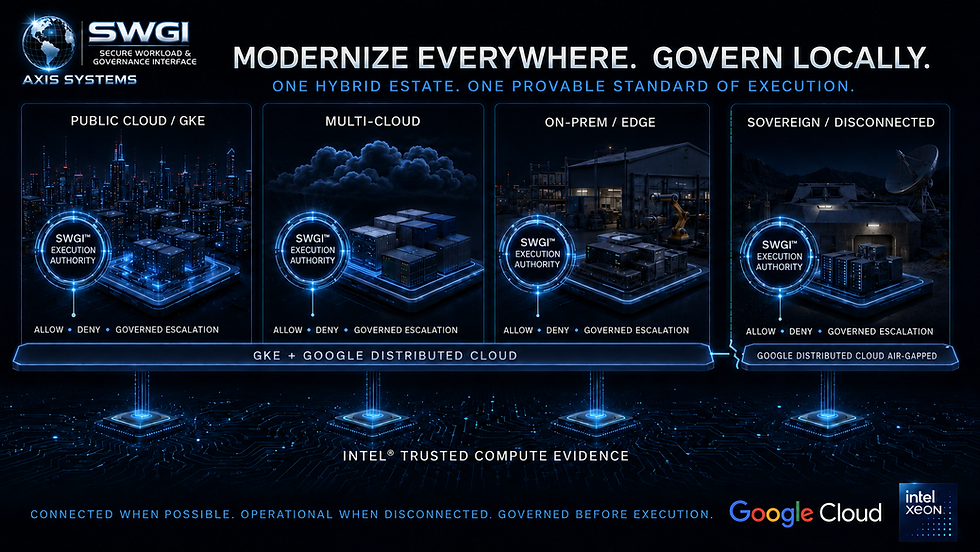
SWGI is designed to deploy inside or near the protected workload across customer-controlled public cloud, multicloud, Kubernetes, on-premises infrastructure, private data centers, edge systems, sovereign environments, air-gapped deployments, and denied, disrupted, intermittent, or limited-bandwidth environments.
The enforcement and data plane remain within the customer’s tenant or infrastructure.
Protected workload data does not need to move through a shared
Axis execution plane for SWGI to make the authority decision.
The platform can govern selected actions across:
Google Kubernetes Engine and Google Distributed Cloud.
Amazon EKS and Microsoft Azure AKS.
Red Hat OpenShift and other Kubernetes environments.
Private-cloud, bare-metal, virtualized, and on-premises infrastructure.
Edge, robotics, autonomous, sovereign, air-gapped, and DDIL systems.
AI agents, APIs, workloads, service-to-service requests, CI/CD pipelines, automation, and privileged operations.
Conclusion: A New Operating Picture
SWGI integrates with the systems organizations already operate, including identity and access management, Kubernetes admission controls, APIs, CI/CD pipelines, policy engines, service meshes, observability platforms, privileged-access workflows, and enterprise AI applications.
Allow-listed decisions, policy events, decision latency, infrastructure measurements, and Trust Receipt references can be correlated through platforms such as Datadog, Splunk, and ConnectWise.
These platforms extend operational visibility; they do not replace SWGI as the execution authority, and customer payloads and encryption keys remain local.
Intel® Xeon®, Intel TDX, Intel SGX, confidential computing, workload-integrity, and attestation evidence can become inputs to the SWGI decision.
Conclusion: A New Operating Picture
SWGI represents a fundamental move away from security as a passive observer and toward security as a runtime authority.
It resolves the fragmented reality of modern infrastructure into a single operating picture that spans Cloud, Edge, and AI.
As we move toward a world of autonomous systems and distributed intelligence, we have to ask: Is a security report that tells you what went wrong after the damage is done still acceptable?
Or is it time to demand an authority that acts before execution occurs?
Connected when possible. Operational when disconnected. Governed before execution.


Comments