From Silicon to Agentic Workflows: What the Expanded Intel - Google Cloud Collaboration Signals for Enterprise AI

Intel and Google Cloud agentic AI infrastructure extends from Intel Xeon silicon and Google Cloud to Enterprise workflows
Industry Insights | Axis Systems
Intel and Google Cloud are expanding a relationship that increasingly connects the full enterprise AI stack - from silicon and cloud infrastructure to autonomous agents, engineering workflows, and semiconductor development.
On July 16, 2026, the companies announced an expansion of their multiyear strategic collaboration.
Intel plans to deploy Gemini Enterprise and Google Cloud capabilities across engineering, supply chain operations, software development, corporate functions, and its broader global workforce.
Google Cloud infrastructure will also augment Intel’s semiconductor development environment, supporting custom agentic workflows intended to accelerate chip design and cross-functional execution.
The announcement is significant because it brings together capabilities that are often discussed separately:
Enterprise AI agents
Semiconductor engineering
High-performance cloud infrastructure
Intel® Xeon® processors
Custom infrastructure processing units
Software development automation
Workload optimization and compute efficiency
Together, these developments point toward a larger architectural shift.
Enterprise AI is moving beyond isolated assistants and individual productivity tools.
Models, agents, enterprise data, cloud resources, processors, and business operations are beginning to function as one increasingly connected operational environment.
That convergence creates considerable opportunity - It also introduces a foundational infrastructure question:
As AI systems gain the ability to initiate consequential workflows, what determines whether a requested action should be allowed to execute?
Intel Is Moving From AI Experimentation to Agentic Operations
The July announcement reflects the continued evolution of enterprise AI from systems that primarily generate information toward systems capable of coordinating work.
Intel plans to use Gemini-powered generative AI across engineering, supply chain, and corporate operations.
The collaboration also identifies agentic coding, software development automation, enterprise data analysis, communications workflows, and semiconductor simulations as areas where AI can improve operational speed and effectiveness.
This represents more than the deployment of another enterprise assistant.
The emerging agentic enterprise is built around systems that can:
Interpret objectives
Identify required information
Coordinate multistep processes
Interact with enterprise applications
Invoke tools and APIs
Generate operational materials
Maintain workflows over extended periods
Recommend or initiate subsequent actions
Google Cloud has positioned Gemini Enterprise as an end-to-end environment for developing, orchestrating, scaling, governing, and optimizing enterprise agents.
Its platform direction includes persistent agents, agent identities, registries, gateways, observability, and centralized governance for workflows that may operate for hours or days.
Intel’s planned adoption provides a meaningful example of where this architecture is heading.
Agentic AI is no longer confined to answering employee questions - it is becoming connected to engineering processes, operational systems, organizational data, and the execution pathways through which enterprises will conduct real work.
Cloud Infrastructure Is Becoming Part of the Chip-Design Environment
The collaboration is not limited to workforce productivity.
Intel also plans to use Google Cloud infrastructure to augment its existing semiconductor-development environment.
According to the announcement, custom agentic workflows and scalable cloud resources will support engineering processes intended to accelerate the chip design lifecycle.
This creates a powerful technology feedback loop:
Intel processors support Google Cloud infrastructure.
Google Cloud infrastructure supports the development of future Intel processors.
Gemini-powered agents help accelerate the engineering and operational workflows surrounding that development.
The resulting infrastructure supports the next generation of enterprise and AI systems.
This is not conventional cloud adoption in which computing capacity is rented to complete an isolated task.
It is an interconnected development architecture spanning silicon, cloud compute, enterprise data, engineering simulation, software automation, and autonomous workflow coordination.
As these layers become more tightly integrated, the distinction between business software and core infrastructure begins to narrow.
An agent operating in an engineering environment may not merely prepare a summary - it may coordinate tools, initiate simulations, retrieve protected information, allocate resources, and influence subsequent stages of development.
The infrastructure must therefore support both greater autonomy and stronger operational control.
The Infrastructure Collaboration Beneath the Agentic AI Story
The July announcement builds upon an infrastructure collaboration announced by Intel and Google in April 2026.
Under that multiyear agreement, the companies are aligning across multiple generations of Intel Xeon processors while expanding the co-development of custom ASIC-based infrastructure processing units, or IPUs.
The stated objectives include improved performance, energy efficiency, infrastructure utilization, workload predictability, and total cost of ownership across Google’s global infrastructure.
Intel Xeon processors continue to support Google Cloud workloads spanning AI coordination, inference, and general-purpose computing.
Custom IPUs independently handle selected networking, storage, and security functions that would otherwise consume host-CPU capacity.
This offload architecture can preserve more computing resources for primary workloads while providing more predictable system performance.
The broader lesson is important:
AI does not operate on models or accelerators alone. It operates on coordinated systems.
Modern AI infrastructure depends on the interaction of:
CPUs and accelerators
Infrastructure processing units
Memory and storage
High-performance networking
Kubernetes and cloud orchestration
Identity and access management
Confidential-computing technologies
Security and policy systems
Workload-governance controls
The effectiveness of the system depends not only on the performance of each component, but on how intelligently the layers work together.
C4N Demonstrates the Importance of Infrastructure-Level Efficiency
Google Cloud’s C4N machine series provides a practical example of this system-level direction - C4N became generally available on July 8, 2026.
The instances are powered by fifth-generation Intel Xeon Scalable processors and Google Cloud’s Titanium offload architecture. They are designed for network-intensive, storage-intensive, distributed computing, analytics, security, and CPU-based AI workloads.
Google Cloud reports that C4N can deliver up to 400 Gbps of network bandwidth while offloading networking and storage functions to dedicated hardware.
The architecture allows organizations to scale compute, storage, and network resources more precisely rather than overprovisioning general-purpose capacity to compensate for I/O constraints.
This illustrates how the economics of enterprise AI will increasingly be determined by more than processor speed.
Organizations must consider:
Where workloads are placed
Which processor handles each operation
How networking and storage functions are offloaded
Whether resources can be allocated dynamically
How much infrastructure remains idle or over-provisioned
Whether a workload is authorized to consume resources at all
The first generation of cloud optimization focused primarily on sizing infrastructure correctly.
The next generation will also examine whether each requested workload should progress into execution.
The most efficiently scheduled unauthorized workload is still an unauthorized workload - preventing unnecessary or policy-violating execution before resources are consumed introduces a complementary dimension of compute efficiency.
Hardware-Rooted Trust Is Becoming Part of the Cloud Foundation
The Intel–Google Cloud ecosystem also demonstrates how trust is moving deeper into the infrastructure stack.
Google Cloud has expanded its Intel Trust Domain Extensions-based confidential-computing capabilities across Confidential VMs, Confidential GKE Nodes, and Confidential Space.
Intel TDX creates hardware-isolated trust domains that protect workload memory and support remote attestation of the execution environment.
Google Cloud has also integrated Intel Trust Authority with supported confidential computing services, which enables organizations to independently verify aspects of a protected environment before sensitive keys or data are released to a workload.
These capabilities address critical questions:
Is the workload operating inside an expected hardware environment?
Has the trusted environment been altered?
Can sensitive data remain encrypted while in use?
Can the integrity of the environment be independently verified?
For sovereign, regulated, and high-assurance computing, these are foundational controls.
They establish greater confidence in where a workload is running and whether the environment can be trusted.
As agentic systems gain operational authority, another question becomes increasingly important:
Even inside an attested and confidential environment, is this specific action authorized to occur?
An authenticated agent can still request an action outside its delegated scope.
An attested workload can still encounter a policy change.
A properly isolated process can still attempt to modify the wrong resource, operate at the wrong time, or consume infrastructure for an unauthorized purpose.
Environmental integrity and action-specific authorization therefore solve related, but distinct, problems.
Agent Sandboxing Strengthens the Execution Environment
Google Cloud’s work on GKE Agent Sandbox further illustrates the infrastructure requirements created by autonomous systems.
GKE Agent Sandbox is designed for isolated, stateful agent workloads, including environments in which untrusted or model-generated code must be executed securely. Google describes kernel-level isolation as one of its central protections.
This is important because autonomous agents increasingly require access to:
Code interpreters
Terminal environments
Enterprise APIs
Internal data sources
External services
Persistent sessions
Specialized tools
Sandboxing helps constrain the environment in which this activity occurs.
Confidential computing helps protect sensitive workloads and data.
Identity systems establish which agent or service is making a request.
The next architectural question is whether the requested action remains valid under current authority, policy, context, and system state.
These controls should not be viewed as substitutes for one another - they are complementary layers within an increasingly mature agentic infrastructure stack.
Emerging Enterprise AI Control Stack

The Agentic Enterprise Creates a New Governance Boundary
Traditional enterprise software generally assumes that authenticated applications and users will operate within predefined workflows.
Agentic systems challenge that assumption.
An agent may determine its next step dynamically - it may select a tool, construct an API request, initiate a workflow, provision a resource, modify a configuration, generate code, or coordinate activity across several systems.
That changes the governance boundary.
It is no longer sufficient to ask only:
Who is the agent?
Was it authenticated?
Which resources can it access?
What happened after it acted?
High-assurance environments must also ask:
Is this agent authorized to initiate this exact action?
Was that authority properly delegated?
Does the authority apply to this target and workload?
Is the request consistent with current policy?
Has the operating context changed?
Should the action consume infrastructure resources?
Can unauthorized execution be prevented before a system state changes?
Can the authorization decision be proven afterward?
Identity establishes who or what is requesting an action.
Confidential computing protects the workload and data environment.
Sandboxing constrains where untrusted execution occurs.
Observability explains what happened.
Execution governance determines whether a requested state transition is permitted to occur at all.
This distinction will become more consequential as agents move from assisting people to operating infrastructure and coordinating business processes autonomously.
Governance Must Follow Authority
The expanded Intel–Google Cloud collaboration signals three major developments.
1. Agentic AI is becoming Operational Infrastructure
Agents are moving into engineering, supply chains, software development, communications, data analysis, and other core business functions - they are becoming persistent participants in enterprise operations rather than isolated productivity features.
2. AI optimization is moving deeper into the technology stack
CPUs, IPUs, cloud instances, networking, storage, confidential computing, orchestration, and workload-specific architectures are being coordinated to improve performance and efficiency at scale.
3. Governance must follow operational authority
As agents gain the ability to initiate actions, enterprise control must extend beyond model behavior and application permissions.
Authority must be evaluated where agent intent becomes an API call, workload request, infrastructure operation, tool invocation, deployment, or consequential system-state transition.
This does not require restricting innovation or closing the agent ecosystem.
It requires clear boundaries around consequential execution.
The enterprise remains open to automation.
Cloud infrastructure remains scalable.
Agents remain capable of coordinating increasingly sophisticated work.
Execution becomes governed where autonomous capability meets systems of consequence.
The Axis Systems Perspective
Axis Systems views the Intel–Google Cloud collaboration as an important indication of where enterprise AI infrastructure is heading.
Intel provides high-performance silicon, infrastructure acceleration, confidential-computing capabilities, and hardware-rooted trust.
Google Cloud provides scalable cloud infrastructure, Kubernetes orchestration, confidential-computing services, and an expanding platform for developing and governing enterprise agents.
Together, these capabilities help establish the performance, scalability, isolation, and trusted infrastructure required for increasingly autonomous enterprise systems.
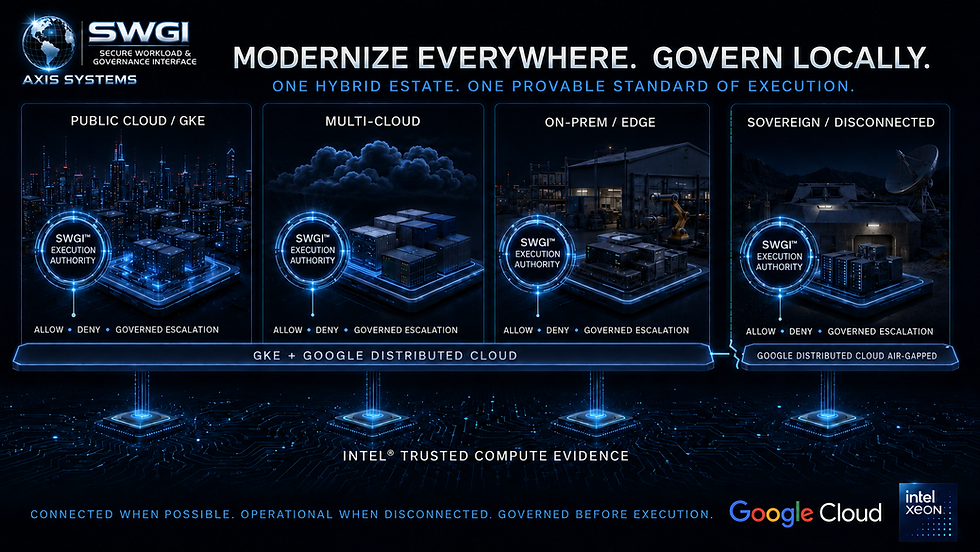
Axis Systems develops SWGI™, a deterministic execution-governance layer designed to evaluate workload authority before execution and generate cryptographic Trust Receipts™ for governed authorization decisions.
The architectural objective is straightforward:
Authorize → Execute → Prove
Within this model, identity evidence and delegated authority can be evaluated alongside policy, context, target resources, credentials, requested actions, and current system state before consequential execution proceeds.
This creates a complementary control layer for sovereign, regulated, and high-assurance environments in which valid identity and secure infrastructure are necessary - but the authorization of each consequential action must also be deterministically and explicitly established.
The emerging stack can therefore be understood as a coordinated system:
Intel silicon establishes performance and hardware-rooted trust.
Google Cloud provides scalable infrastructure, orchestration, confidential computing, and agent platforms.
SWGI™ introduces deterministic execution governance at the boundary of action
Trust Receipts™ preserve verifiable evidence of the resulting authorization decision.
The next phase of enterprise AI will not be defined only by more capable models.
It will be defined by whether organizations can safely connect intelligence to infrastructure, data, compute resources, business operations, and real-world authority.
Intel and Google Cloud are helping build the infrastructure that makes the agentic enterprise possible.
The wider ecosystem must ensure that autonomous capability is matched by trusted environments, bounded authority, compute efficiency, deterministic control, and verifiable proof.
Editorial Disclosure
Axis Systems participates independently in the Intel and Google Cloud partner ecosystems.
Axis Systems was not involved in the collaborations, deployments, products, or announcements analyzed in this article, and no involvement, endorsement, or commercial relationship concerning these specific initiatives should be inferred.
This article represents Axis Systems’ independent industry perspective on public developments affecting AI infrastructure, agentic systems, confidential computing, compute efficiency, and execution governance.

Comments