How Much of Today's Compute Demand Actually Needs to Exist?
Updated: Jul 16

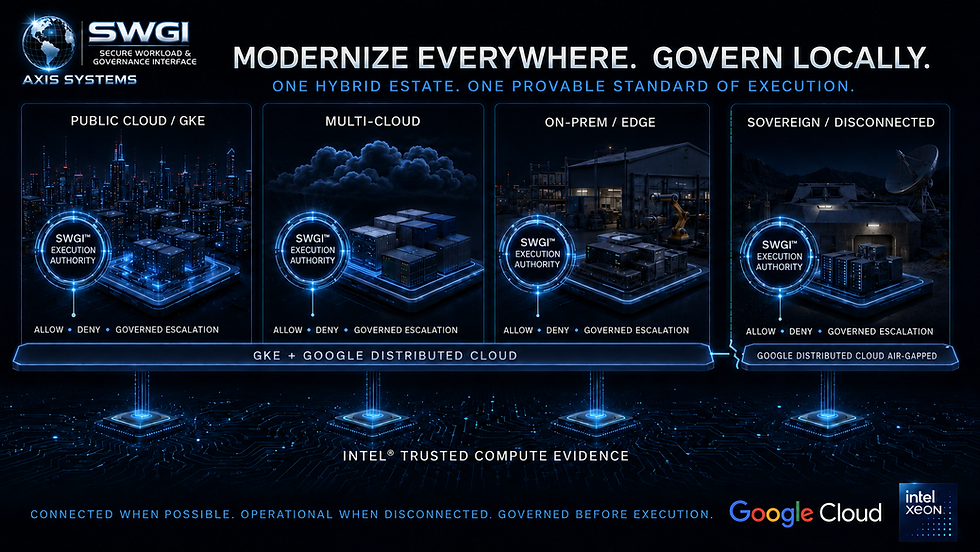
SWGI™ pre-execution authorization infographic showing deterministic governance, compute efficiency, capacity recovery, cloud economics, Zero Trust, compliance alignment, and infrastructure optimization for sovereign AI environments.
The industry has spent decades optimizing performance, increasing processor density, improving storage technologies, and expanding network capacity. Far less attention has been given to a simpler question:
Should a Workload Execute at All?
As AI adoption accelerates, that question may become one of the most important economic considerations in modern infrastructure.
The Hidden Cost of Uncontrolled Execution
Modern infrastructure is remarkably efficient at executing workloads. It is far less efficient at determining whether those workloads should execute in the first place. Unauthorized workloads, misconfigured workloads, abandoned workloads, duplicate jobs, zombie processes, over-provisioned automation, and policy-violating workloads all consume infrastructure resources regardless of whether they create meaningful business value.
Traditional governance models identify these issues after execution has already occurred. By the time an alert is generated, compute resources have already been consumed. Storage has already been allocated. Network traffic has already been generated. Power has already been consumed. The result is a structural inefficiency that exists across cloud, enterprise, and public-sector environments.
Why Pre-Execution Authorization Changes the Economics
Pre-execution authorization introduces a fundamentally different model. Instead of governing workloads after execution, governance occurs before execution. A workload is evaluated against authority, policy, context, compliance requirements, and execution conditions before compute resources are allocated. If authorization requirements are satisfied, execution proceeds. If authorization requirements are not satisfied, execution does not occur.
The logic is intentionally simple: Authorized = Execute and Unauthorized = Do Not Execute. This binary decision model creates a new economic dynamic within infrastructure. Every workload prevented from executing unnecessarily represents compute capacity that remains available for productive use. Every unauthorized execution event avoided represents infrastructure resources that never needed to be consumed. The economic implications of this shift may be substantial.
Compute Efficiency as a Strategic Resource
The conversation around AI infrastructure is often framed around acquiring more resources: more GPUs, more servers, more storage, more racks, more power, and more data centers. Yet many organizations may already possess significant unused capacity hidden within existing environments. When unnecessary execution is reduced, available infrastructure capacity increases.
Compute resources can be redirected toward higher-value workloads. Storage systems experience less unnecessary growth. Network resources become more efficient. Infrastructure teams gain greater operational visibility. The result is not simply improved security; it is improved infrastructure economics. Across large-scale environments, even modest reductions in unnecessary execution activity can have meaningful implications for utilization, operating costs, and long-term infrastructure planning.
Capacity Recovery and the Data Center Equation
Data centers are facing increasing pressure. AI workloads continue to grow. Power demand continues to rise. Cooling requirements continue to expand. Capital expenditure requirements continue to increase. At the same time, organizations face mounting pressure to maximize utilization of existing assets. Pre-execution authorization introduces a mechanism for reducing unnecessary workload activity before resources are consumed.
If organizations can recover a meaningful percentage of currently wasted compute capacity, the implications become significant. Additional workloads can be supported without immediate infrastructure expansion. Server utilization can improve. Storage growth rates can slow. Procurement cycles can become more efficient. Data center expansion timelines can potentially be extended. In this model, capacity becomes a governance issue as much as an infrastructure issue. The most efficient server is not necessarily the fastest server; it may be the server that avoids unnecessary execution altogether.
Green Compute and Infrastructure Sustainability
The conversation around AI increasingly includes energy consumption. Governments, cloud providers, enterprise sustainability teams, investors, and regulators are all examining the environmental impact of growing computing demand. The most sustainable computing resource is often the one that never needs to be consumed. Green Compute begins with eliminating unnecessary execution.
By reducing workload activity before resources are allocated, organizations can potentially lower energy consumption, improve infrastructure utilization, and reduce operational waste. This creates alignment between infrastructure efficiency and sustainability objectives. Compute efficiency becomes an environmental strategy as well as an operational strategy. As organizations pursue sustainability goals, governance and efficiency increasingly become interconnected.
Compliance by Design, Not After the Fact
Modern compliance frameworks increasingly require organizations to demonstrate not only what occurred but also who authorized it, why it was permitted, and whether execution complied with established policy. Traditional compliance models often depend on logs, screenshots, manual reviews, and post-event reconstruction. Deterministic Governance changes that model.
By introducing authorization before execution, organizations gain the ability to enforce policy directly within the execution pathway rather than relying exclusively on post-execution controls. This approach supports alignment with frameworks and initiatives, including:
NIST Cybersecurity Framework (CSF)
NIST SP 800-53
FedRAMP
CMMC
ISO 27001
SOC 2
Zero Trust initiatives
Internal governance and audit programs
Trust Receipts™ and verifiable authorization records create an audit-ready foundation for regulated and high-assurance environments. Instead of asking what happened after execution, organizations gain the ability to demonstrate why execution was authorized in the first place.
The Convergence of Zero Trust, Compliance, and Economics
The pressure to improve infrastructure governance is now coming from every direction. From the top down, regulators, auditors, boards of directors, insurers, and government agencies increasingly expect organizations to demonstrate accountability, compliance, operational transparency, and Zero Trust principles. From the bottom up, infrastructure teams face growing operational complexity. Security teams face escalating alert fatigue. Cloud teams face rising infrastructure costs. Compliance teams face expanding reporting requirements. Operations teams face increasing demands with limited resources. The result is a convergence of priorities.
Security teams want stronger controls. Compliance teams want better evidence. Infrastructure teams want greater efficiency. Executives want improved economics. Everyone is ultimately asking for the same outcome: More control. Less waste. Better accountability. Pre-execution authorization sits at the intersection of all three.
Security and Compliance as Economic Multipliers
Historically, security and compliance have often been viewed as cost centers. Organizations invest in controls, audits, monitoring platforms, reporting systems, consultants, and compliance programs to reduce risk and satisfy regulatory obligations. While necessary, these investments frequently operate as defensive expenditures. Pre-execution authorization introduces a different economic model.
When governance occurs before compute resources are consumed, security and compliance controls can directly influence infrastructure utilization. Unauthorized workloads never execute. Misconfigured workloads never consume resources. Policy-violating activity can be prevented before infrastructure capacity is allocated. The result is a direct relationship between governance and operational efficiency. Organizations may experience:
Reduced unnecessary compute consumption
Improved infrastructure utilization
Delayed capital expenditure requirements
Slower storage growth
Reduced cloud waste
Lower operational overhead
Improved audit readiness
Reduced compliance administration costs
In this model, governance becomes more than a security function. It becomes an infrastructure optimization function. Compliance becomes more than a reporting requirement. It becomes part of capacity management. Security becomes more than risk reduction. It becomes part of the economics of infrastructure itself.
The Infrastructure Economics Question
For decades, infrastructure strategy has focused on increasing capacity. More processors, more storage, more racks, more power, more data centers, and more cloud spending. Pre-execution authorization introduces a different question: What if organizations could increase effective capacity without building additional capacity?
Every unnecessary workload prevented from executing leaves resources available for productive work. Every avoided execution event reduces infrastructure demand. Every improvement in governance has the potential to create operational, financial, compliance, and environmental benefits simultaneously. This is where the economics become compelling.
The future of infrastructure may not be determined solely by how much compute can be built. It may be determined by how intelligently execution is governed. As AI adoption accelerates, organizations will increasingly face a choice: continue expanding capacity to support unnecessary execution or introduce governance capable of determining whether execution should occur in the first place. The difference between those two models may ultimately define the next decade of infrastructure economics.
SWGI™ | Deterministic Governance for Sovereign AI Infrastructure.

Comments