Authorization Before Robotic Action: Execution Governance for Autonomous Systems and Critical Infrastructure
Why machine-speed systems need authority before action, not just monitoring after the consequence.
Execution is moving from digital activity into physical consequence. In autonomous systems, smart grids, operational technology, and critical infrastructure, a command can become movement, voltage, routing, shutdown, machine-state change, or operational impact. This article explains why execution governance must move before action — validating authority, enforcing policy, and generating proof before machine-driven systems affect real-world environments.
Digital execution is moving off the screen and into real-world infrastructure.
What used to be “software activity” can now become movement, voltage, routing, shutdown, machine-state change, or operational consequence.
That shift changes the governance question.
In traditional software environments, a bad workload may create downtime, cost, telemetry noise, audit exposure, or a security incident. Those outcomes matter, but they usually remain inside the digital infrastructure layer.
Autonomous systems and critical infrastructure are different.
In these environments, execution can create physical consequences.
A robotic command can become movement.
A smart grid instruction can affect power flow.
An industrial workload can influence equipment behavior.
An operational technology signal can interact with PLC, SCADA, sensor, or edge environments.
A public-sector infrastructure action can become more than a cybersecurity event. It can become an operational risk.
That is why execution governance must move earlier.
Not after the action.
Before the action.
SWGI™ provides the execution-governance foundation: validate authority before action, enforce policy before state change, and generate Trust Receipts™ after authorized execution.
The deeper issue is not the framework itself.
The deeper issue is what happens when digital execution creates physical consequences.

SWGI™ execution governance connects digital activity to physical consequence - validating authority before action, enforcing policy before state change, and generating Trust Receipts™ after authorized execution.
Execution Leaves the Screen
Modern infrastructure is no longer confined to passive software systems.
AI agents can trigger workflows.
Robotic systems can move through physical environments.
Industrial automation can respond to digital commands.
Smart grids can route power dynamically.
Operational technology can interact with cloud-connected workloads.
Critical infrastructure can be influenced by software-defined decisions.
That creates a new control problem.
A command is no longer just a command.
In autonomous robotics, a command may become movement.
In industrial systems, a workload may affect equipment behavior.
In smart grids, an instruction may affect power flow.
In operational technology, a software action may interact with PLCs, SCADA systems, sensors, or edge environments.
In public-sector and utility infrastructure, a bad execution decision can become more than a cybersecurity event. It can become an operational risk.
This is where execution governance becomes a high-assurance infrastructure discipline.
The Timing Problem
Traditional security and observability models are useful, but they often operate too late for autonomous and infrastructure-connected environments.
The older model looks like this:
A system acts.
A log is created.
A monitoring tool observes behavior.
An alert is generated.
A team investigates.
That process still matters.
But when machine-speed execution creates physical consequences, post-event visibility is not enough.
By the time an alert is reviewed, the robot may have moved.
The industrial process may have changed state.
The grid command may have propagated.
The utility system may have adjusted routing.
The edge device may have executed the instruction.
The question cannot be only:
Did we detect what happened?
The stronger question is:
Was the action authorized before it was allowed to affect the environment?
That is the shift.
From monitoring digital activity after the fact to governing machine-driven execution before consequence.

Simulation Mode: Authorization Before Action. SWGI™ evaluates machine-driven commands through authority validation, policy checks, context review, system-state evaluation, risk flags, and Trust Receipts™ before allowing robotic movement, grid instructions, OT control signals, or infrastructure state changes to proceed.
Authorization Before Robotic Action
Autonomous systems need more than intelligence.
They need authority.
A robotic system may receive instructions from an AI model, sensor input, remote operator, software workflow, control system, or automated decision engine. But the fact that a system can act does not mean the action should be allowed.
For robotics, execution governance applies to actions such as:
Movement commands
Object manipulation
Restricted-zone access
Tool activation
Route changes
Human-proximity operations
Industrial robot behavior
Autonomous vehicle decisions
Machine-state transitions
AI-generated command execution
The governance question is direct:
Is this action authorized under the current identity, policy, operational context, system state, and environmental condition?
That matters because robotic execution can cross the line from digital decision to physical movement.
A bad model output may become a motion command.
A compromised workflow may become equipment behavior.
An unauthorized instruction may grant access to a restricted area.
A misclassified command may create a safety issue.
Deterministic governance does not remove autonomy.
It makes autonomy accountable.
The goal is not to slow down machine systems.
The goal is to ensure that high-impact machine actions are authorized before they occur and provable after they occur.
Execution Governance for Smart Grids and Critical Infrastructure
Critical infrastructure carries the same problem on a larger scale.
Smart grids, utilities, energy systems, water systems, transportation networks, telecommunications infrastructure, and public-sector operating environments are becoming more connected, automated, and software-defined.
That creates efficiency.
It also increases the number of execution points.
A grid instruction, routing decision, edge-device command, utility operation, or infrastructure control signal may begin as software but end as a real-world operational change.
That makes execution authority critical.
For smart grids and critical infrastructure, execution governance must consider:
Who requested the action?
What authority supports it?
What asset is affected?
What system state exists right now?
What policy applies?
What operational context matters?
What risk exists if the command executes?
Can the decision be proven afterward?
This is not simply about blocking malicious activity.
It is about making sure infrastructure actions are validated before they create a state change.
In critical environments, authority cannot be assumed just because a command is technically possible.
Operational Technology and IT Convergence
The convergence of IT and OT makes this issue more urgent.
Legacy industrial control environments were not originally designed for modern AI-driven, cloud-connected, API-based, externally orchestrated workloads.
Yet that convergence is already happening.
Cloud systems are connecting to industrial workflows.
AI models are being applied to plant operations.
Remote monitoring is expanding.
Edge devices are becoming more intelligent.SCADA and PLC environments are interacting with broader digital infrastructure.
This creates a trust gap.
Modern workloads are entering environments that were not built to trust them by default.
A workload may be visible.
A command may be technically possible.
An automation may be triggered.
A system may be connected.
But execution should still require authority.
That is the difference between connectivity and control.
IT/OT convergence cannot rely only on visibility after execution.
It needs governance before execution.
The Binary Decision Layer
In high-assurance environments, ambiguity is expensive.
A system either has the authority to execute, or it does not.
That is why binary execution governance matters:
1 = Authorized
0 = Denied
If authorized, the action proceeds and can generate evidence.
If denied, the action stops before it creates risk, cost, state change, safety exposure, or operational consequence.
This creates a cleaner operating discipline:
No assumed execution.
No silent authority.
No high-impact action without validation.
No operational consequence without proof.
For autonomous systems and critical infrastructure, this is not theoretical.
It is the difference between watching a system act and governing whether it is allowed to act.
Trust Receipts™ as Proof of Authorized Action
Logs are useful, but logs often describe what happened after the fact.
High-assurance environments need stronger evidence.
A Trust Receipt™ can show that an action was authorized before it occurred.
That distinction matters.
For autonomous systems, a Trust Receipt can support proof that a robotic action passed authority checks before movement or machine-state change.
For critical infrastructure, a Trust Receipt can support proof that an operational command was policy-cleared before affecting infrastructure state.
For regulated environments, Trust Receipts can support auditability, compliance evidence, operational accountability, and post-event reconstruction.
The value is not only recording that an action happened.
The value proves that the authorization decision existed before the action.
Simulation Mode: Authorization Before Robotic Action
A simulation model for robotic execution governance can evaluate the action before physical movement occurs.
A high-level simulation may include:
Requested action
AI-generated instruction
Operator identity
Robot identity
Device authority
Physical environment
Human-proximity condition
Restricted-zone status
Safety boundary
Policy condition
Execution scope
Authorization decision
Trust Receipt output
The result is binary:
Authorized action proceeds.
Unauthorized action is denied.
This allows organizations to model the decision point before robotic action occurs, instead of only reviewing what happened afterward.
Simulation Mode: Smart Grid Command
A smart-grid execution-governance simulation can evaluate whether an operational command should execute before it changes the grid state.
A high-level simulation may include:
Command request
Grid asset identity
Operator authority
System state
Load condition
Regional policy
Criticality level
Risk flag
Execution scope
Authorization decision
Trust Receipt output
The purpose is not only to detect an issue.
The purpose is to determine whether the command has authority before infrastructure state changes.
That is the difference between observing infrastructure and governing infrastructure.
Infrastructure Alignment: Cloud and Hardware Trust
Execution governance for autonomous systems and critical infrastructure requires the right infrastructure lanes to be clearly separated.
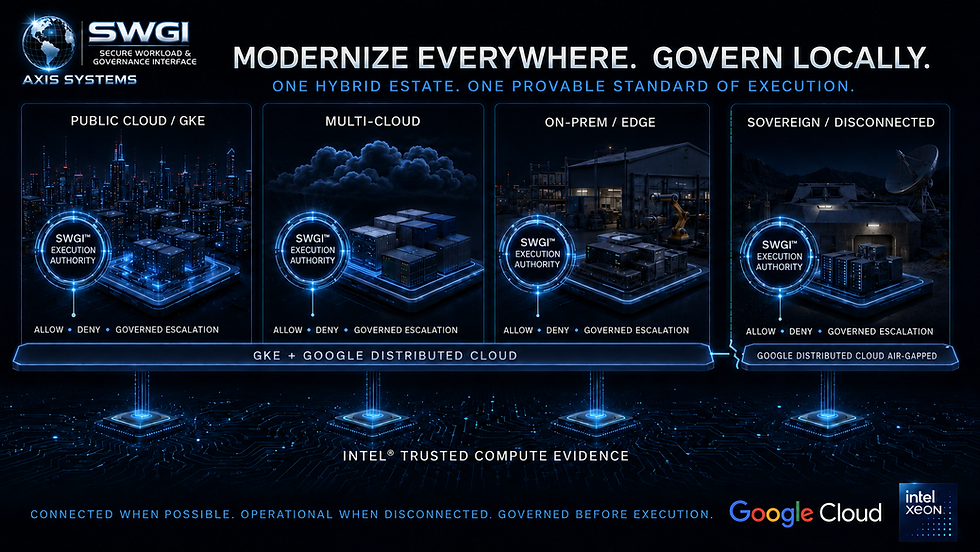
Google Cloud / GCP fits the cloud and Kubernetes deployment lane, including Google Kubernetes Engine, Anthos, hybrid, sovereign, and edge-aligned environments.
Intel® fits the hardware-trust and confidential-compute lane, including Intel® Confidential Computing, Intel® SGX, Intel® TDX, TPM-based attestation, and hardware-rooted execution assurance.
SWGI™ sits between digital command and physical consequence as the execution-governance layer.
Cloud infrastructure supports deployment.
Trusted hardware supports hardware-rooted assurance.
SWGI™ governs whether execution is authorized before action occurs.
Where This Applies
The autonomous systems and critical infrastructure lane includes:
Autonomous robotics
Industrial automation
Humanoid systems
Autonomous mobile robots
Smart power grids
Energy and utilities
Water systems
Transportation networks
Telecommunications infrastructure
SCADA environments
PLC-connected workflows
Edge infrastructure
Public-sector operational systems
Defense-adjacent infrastructure
Mission-critical facilities
Different environments.
Same high-assurance standard:
Authorize before execution.
Prove after authorization.
Why This Is Bigger Than Cybersecurity
This discussion is often placed under cybersecurity, but that framing is too narrow.
Execution governance also touches:
Operational safety
Infrastructure resilience
Auditability
Compliance evidence
Industrial reliability
AI governance
Human oversight
Autonomous system assurance
Critical infrastructure modernization
Public-sector accountability
In autonomous systems, the question is not only whether software is secure.
The question is whether the machine was authorized to act.
In critical infrastructure, the question is not only whether the network is protected.
The question is whether a command was authorized before it changed operational state.
That is why execution governance becomes an infrastructure-control discipline.
Conclusion
The next generation of infrastructure will not only be judged by how intelligent it is.
It will be judged by how well it governs action.
As AI systems become more autonomous and infrastructure becomes more software-defined, execution can no longer be treated as automatic - it must be Deterministic.
A robotic action should be authorized before movement.
A grid command should be authorized before a state change.
An industrial workload should be authorized before machine impact.
A mission-critical operation should be authorized before any consequences.
The older model explains what happened.
The stronger model governs what is allowed to happen.
That is the future of execution governance for autonomous systems and critical infrastructure.

Comments