Secure Workloads, Stronger Governance: Intel Confidential Computing and Axis SWGI™
Protect sensitive data. Govern execution. Build reviewable evidence for enterprise security, public-sector deployment, and ATO preparation.

A secure infrastructure investment should deliver something practical: greater confidence in running the workloads that matter to your organization.
That means protecting sensitive information while it is being processed.
It also means making sure an application, automated workflow, or AI agent operates within its authorized scope.
These responsibilities belong together, but they are not interchangeable.
Intel® confidential computing technologies provide hardware-backed protection for data in use.
Axis SWGI™ execution governance on Intel infrastructure addresses another responsibility: evaluating whether a protected operation is authorized before it proceeds and preserving evidence of that decision.
The objective is straightforward: protected workloads operating under explicit policy, with a record that security and operations teams can review.
For government and public-sector organizations, the planning should also address acquisition and system authorization.
What will be purchased?
Where will it operate?
Which actions will be governed?
What evidence will be available for assessment?
Those questions should be part of the deployment conversation from the beginning.
What Intel confidential computing provides

Confidential computing helps protect data during processing - not only while it is stored or moving across a network.
Intel offers different protection boundaries for different application and infrastructure requirements. Intel
Intel SGX: protect selected code and data
Intel® Software Guard Extensions, or Intel® SGX, supports protected application environments called enclaves.
These enclaves isolate selected code and data, helping protect sensitive operations from software outside the enclave, including privileged host software.
Remote attestation provides evidence that a verifier can evaluate before sharing sensitive information with the enclave. Intel
Intel TDX: protect the virtual machine
Intel® Trust Domain Extensions, or Intel® TDX, protects at the virtual-machine level.
Hardware-isolated virtual machines, called trust domains, help protect workload confidentiality and integrity from the host virtual-machine manager and other software outside the trust domain.
Attestation provides evidence about the environment that can be checked against the organization’s requirements. Intel
Intel TDX Connect: extend protection toward I/O
Intel® TDX Connect extends confidential computing toward compatible connected devices.
It enables encrypted communication between a confidential virtual machine and an enabled PCI Express device.
That matters for workloads using accelerators, networking devices, or storage: protecting the CPU environment is only part of the picture when sensitive data also moves between components. Intel Community
Deployment requires compatible processor capabilities, enabled devices, and appropriate operating-system or hypervisor support.
The exact configuration matters; these protections should not be assumed simply because a system uses an Intel processor. Intel Community
For buyers, the practical question is not just whether confidential computing appears on a specification sheet - it is whether the selected configuration provides the protection boundary the workload requires.
Protecting an environment and authorizing an action are different jobs
Consider an automated application running in a confidential virtual machine.
Suppose the environment meets the organization’s security requirements, the application has a valid identity, and sensitive data is protected during processing.
Now the application requests a change to a production configuration.
The organization still needs to determine whether that particular change is allowed.
Does the request fall within the application’s permitted scope?
Is production an approved target?
Does the operation require human approval?
Is the requested change consistent with the applicable policy?
The environment’s protection does not answer every one of those questions.
They concern the authority granted to the application and the specific action it is attempting.
Knowing where a workload is running and deciding what it may do are separate parts of the same security design.
That distinction is useful when planning a deployment.
Hardware protection, identity, policy enforcement, and runtime monitoring should have clear responsibilities rather than being treated as substitutes for one another.
Where Axis SWGI fits

SWGI is Axis Systems’ execution-governance platform.
Its role is to evaluate authority before protected workloads or operations proceed, using relevant policy, identity, intent, target, environment, and system-state information.
Trust Receipts preserve the resulting decision and supporting evidence. Axis Systems
The operational goal is simple: put the policy decision in the path of the action it governs.
Consider a deployment policy requiring an approved workload identity, an approved software artifact, and acceptable environment evidence.
The protected deployment should proceed only when those conditions are satisfied.
A request that fails the policy should not continue through that control point.
The scope of that control must also be explicit.
Governing a workload’s deployment is not automatically the same as governing every operation the workload performs afterward.
A deployment gate and a control governing a sensitive application action protect different boundaries.
For a scoped SWGI deployment, the working questions are therefore concrete:
Which operation is protected, where is it intercepted, what policy applies, and what evidence demonstrates that enforcement worked?
That is how a security objective becomes something a team can configure, test, and review.
Trust Receipts make authorization decisions reviewable
An authorization decision should leave a useful record -not an unanswered question during an investigation or assessment.
The SWGI Trust Receipt™ model connects the request, relevant identity, governing policy, decision, and supporting references in a signed, tamper-evident evidence object.
The model includes denied decisions as well as permitted ones, helping reviewers understand when policy refused an action. Axis Systems
What was requested, which policy applied, and what decision was made?
Those are the questions the record should help answer.
Authorization evidence must also remain distinct from execution evidence.
Permission to operate does not establish that it completed successfully or produced a correct result.
Linking the decision to runtime records provides the additional context needed to assess the outcome. Axis Systems
This is not about replacing useful logs. It is about connecting operational activity to the authorization decision that preceded it.
For a deployment review, define both parts: the evidence showing what was permitted and the evidence showing what happened afterward.
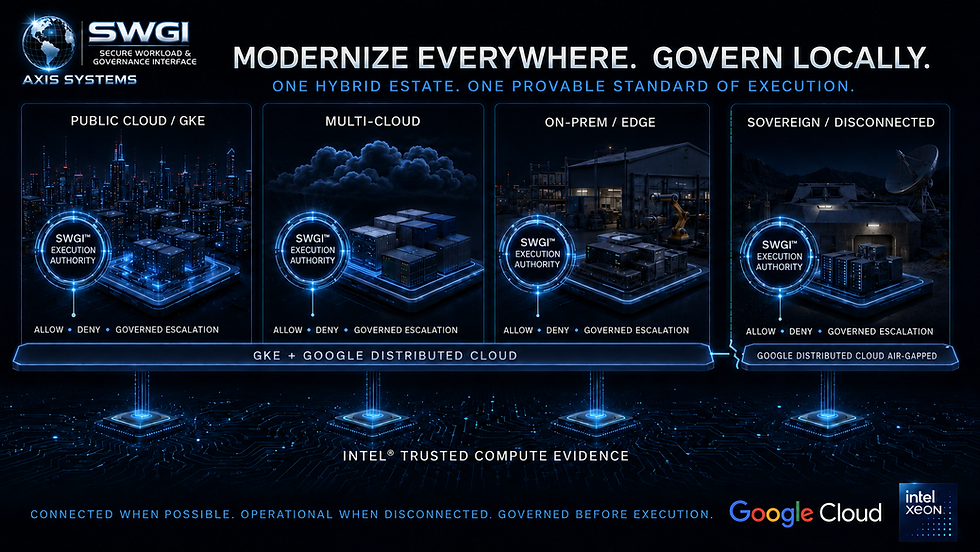
A practical approach to hybrid and multi-cloud governance
A hybrid or multi-cloud governance strategy should not assume that every environment has identical capabilities.
The useful objective is consistent policy intent, enforced through appropriate controls in each supported environment.
Axis explores this approach in Modernize Everywhere. Govern Locally, which connects distributed infrastructure with governance at the relevant execution boundary. Axis Systems
A practical starting point is one protected workflow: a sensitive workload launch, a production deployment, or a privileged automation request.
Establish what must be true before the operation proceeds. Identify the enforcement point.
Decide what evidence must be retained.
Then test the boundary.
An approved request should proceed through the intended path.
An out-of-policy request should be denied.
Missing required evidence should not silently become permission.
Attempts to bypass the enforcement point should be part of the evaluation.
The same discipline should apply to environment-specific protections.
A workflow requiring confidential-computing evidence should be evaluated against the capabilities of its actual deployment - not against a general assumption about the cloud or hardware brand.
Start with a boundary that can be demonstrated, then expand to additional workflows and environments.
Authority to Operate (ATO): connect policy to reviewable evidence
An Authority to Operate (ATO) effort needs more than a product description. It needs evidence about the system being assessed.
NIST uses the term Authorization to Operate for the formal management decision permitting system operation and accepting the associated risk based on implemented security and privacy controls.
That decision belongs to the designated authorizing official. NIST Computer Security Resource Center
This is different from an SWGI decision permitting an individual protected action.
One concerns acceptance of system-level risk; the other concerns whether a specific operation satisfies the policy enforced at its control point.
Build the evidence around the control
For a scoped deployment, consider how authorization-decision records could contribute to the assessment evidence for a relevant control.
A useful review package would connect the protected request, applicable policy, decision, and supporting identity or environment references.
Pair those records with configuration documentation, enforcement tests, and linked runtime activity.
For example, a team governing production workload deployment could demonstrate that approved requests proceed, out-of-policy requests are denied, and decision records can be verified.
It should also document the enforcement boundary and test attempts to bypass it.
This is a proposed way to organize evidence - not a claim that a particular receipt or product automatically satisfies an assessment requirement.
The NIST Risk Management Framework connects control implementation, assessment, authorization, and continuous monitoring.
Its Monitor step uses ongoing information about systems and control effectiveness to support risk decisions.
Relevant execution-governance evidence can be evaluated within that broader process alongside other system evidence. NIST Computer Security Resource Center
SWGI can contribute authorization-decision evidence to ATO preparation; it does not issue or guarantee an ATO.
A Trust Receipt is supporting evidence, not an agency approval or a complete authorization package. Axis Systems
Government and public-sector procurement through Carahsoft
A strong technical fit also needs a practical acquisition path.
The Axis Systems storefront on Carahsoft gives public-sector buyers a place to review SWGI solution information, contact Carahsoft’s Axis Systems team, and request a quote. Carahsoft
For federal, defense, state and local government, and public-education teams evaluating confidential computing or hybrid-cloud governance, start with a defined requirement.
Identify the workload, deployment environment, protected operation, policy requirements, and evidence needed for security review - that gives technical, acquisition, and assessment teams a common scope.
Ask Carahsoft’s Axis team to confirm the current product and SKU details, pricing, reseller arrangements, and any applicable contract vehicle for the intended purchase.
Confirm eligibility and coverage for the specific requirement rather than assuming that every procurement route applies.
Plan the purchase. Prepare the evidence.
Review SWGI solution information and discuss public-sector procurement with Carahsoft’s Axis Systems team. Carahsoft
The distinction between acquisition and authorization remains important:
Procurement answers how you acquire the solution. An ATO addresses whether the system is authorized to operate.
Purchasing through a channel does not replace the system’s security assessment or the authorizing official’s risk decision. NIST Computer Security Resource Center
Align the purchase scope with the deployment and assessment scope: what will be governed, where it will run, and what evidence will be delivered.
Start with a workload that matters
The strongest starting point is a specific operational question:
Which action in our environment needs a clearer authorization boundary?
From there, evaluate the workload’s protection requirements, available hardware capabilities, applicable policy, and integration needed to enforce that policy.
For hardware planning, Intel’s Xeon buying directory provides routes to participating system providers. Confirm the selected configuration’s confidential-computing capabilities before procurement. Intel
For solution planning, explore Axis SWGI on Intel infrastructure and the Intel Xeon buying directory. Axis Systems
The goal is not another layer of terminology.
It is a deployment where the organization can demonstrate what is protected, what is permitted, and what evidence supports the decision.
Intel confidential computing provides hardware-backed workload protection.
SWGI adds policy-based execution governance. The value is in making those responsibilities work together. Intel
Discuss your deployment
Contact Axis Systems to discuss a scoped SWGI deployment for confidential-computing, hybrid-cloud, or multi-cloud environments.
Government and public-sector teams can visit Axis Systems on Carahsoft for solution information, quote requests, and procurement coordination.
Featured artwork: Intel. The security-assurance comparison shown in the image cites ABI Research (2023). See Intel processor claims and disclosures for the reference printed in the artwork. Intel technologies may require enabled hardware, software, or service activation. Capabilities depend on configuration; no product or component can be absolutely secure.

Comments