Briefing: SWGI™ Platform Executive Summary
Updated: Jul 2
Axis Systems is establishing Deterministic Execution Governance as a new infrastructure category for AI, autonomous systems, cloud-native workloads, sovereign environments, and high-assurance infrastructure.
Through SWGI™ - Secure Workload Governance Interface - Axis Systems introduces a deterministic execution-governance platform built upon Intent-Aware Architecture.
The platform validates intent, authority, policy, identity, execution context, workload scope, and operational requirements before workloads, AI agents, autonomous systems, and privileged operations are allowed to execute.
This shifts infrastructure security from a post-execution model to a prevention-first model:
Authorize → Execute → Prove
Rather than relying on detection, monitoring, and remediation after activity has occurred, SWGI™ moves governance to the execution boundary.
The goal is to determine whether execution should occur before compute resources are consumed, state changes are allowed, telemetry expands, or compliance exposure is created.
SWGI™ helps public-sector, regulated, and mission-critical organizations validate authority before execution, generate cryptographic Trust Receipts™, strengthen compliance evidence, reduce ghost compute, recover capacity, and improve infrastructure efficiency across AI, autonomous systems, cloud-native, hybrid, sovereign, edge, and high-assurance environments.
The result is not only stronger security.
It is better execution accountability, stronger audit evidence, reduced infrastructure waste, improved compute utilization, and a more deterministic operating model for modern digital infrastructure.
Deterministic Enforcement

The Core Problem: Execution Is Still Treated as Automatic
Modern infrastructure is becoming more autonomous, distributed, and compute-intensive.
AI workloads, agentic systems, Kubernetes clusters, privileged operations, APIs, service meshes, robotic systems, edge environments, and cloud-native workloads increasingly execute at machine speed. But most security and compliance models still assume that execution happens first and governance happens later.
Logs have already expanded.
Telemetry has already increased.
The state may have already changed.
Power has already been drawn.
Heat has already been generated. Compliance exposure may already exist.
The question is no longer only:
Who has access?
The deeper question is:
Should this execution be allowed to occur at all?
SWGI™ targets that gap by applying deterministic enforcement before execution, helping organizations prevent unauthorized, unnecessary, non-compliant, or wasteful activity before it becomes risk, cost, infrastructure burden, or audit exposure.
Core Framework: Intent-Aware Architecture
At the center of Axis Systems’ infrastructure thesis is Intent-Aware Architecture.
IAA changes the default assumption from " Execution happens unless blocked "
To Execution occurs only after authority is validated.
The simplified operating primitive is:
Execution = Intent + Authority
This means execution is not treated as automatic. Every governed action must resolve through a deterministic authorization process before compute resources are consumed.
SWGI™ evaluates the requested action against policy, identity, authority, execution context, workload scope, and operational requirements.
The result is binary.
Authorized execution proceeds. Unauthorized execution is denied before compute is consumed.
This creates a new control layer for modern infrastructure: deterministic enforcement before execution.
The Binary Governance Model
SWGI™ applies a binary governance model to execution events.
Every governed action resolves as:
1 = Authorized
0 = Denied
This binary structure matters because high-assurance infrastructure cannot depend only on interpretation after the fact. Execution must be governed in a way that is deterministic, auditable, and enforceable.
If the action is authorized, execution proceeds, and evidence can be generated.
If the action is unauthorized, SWGI™ denies the action before it consumes compute, produces unnecessary telemetry, generates avoidable cost, or creates operational risk.
This is the shift from reactive monitoring to deterministic enforcement.
From Monitoring to Execution Authority
Traditional observability, security, and compliance tools remain important. They help organizations understand activity, detect anomalies, review logs, measure posture, and respond to incidents.
But those tools generally operate after execution has already been allowed.
SWGI™ is different.
It functions as an execution-governance and authority layer.
Instead of asking only what happened, SWGI™ asks whether execution should occur before it happens.
This advances Zero Trust from access control into execution control.
The stronger model becomes:
Authorize → Execute → Prove
Not merely:
Authenticate → Monitor → Remediate
This distinction matters because a workload can come from a valid identity, operate inside an approved environment, and still be unnecessary, over-permissioned, duplicated, misconfigured, abandoned, policy-violating, or wasteful.
SWGI™ is built to challenge that execution before it becomes risk, cost, heat, telemetry overhead, compliance exposure, or infrastructure expansion.
Technical Capabilities and Integration
SWGI™ is engineered for modern, distributed infrastructure with a focus on low-latency enforcement, Kubernetes-native operations, compliance evidence, confidential computing alignment, and infrastructure efficiency.
Sub-Millisecond Authorization
SWGI™ is designed for low-latency authorization at operational speed, with baseline validation demonstrating approximately 0.2-millisecond authorization latency, depending on environment, workload profile, and implementation conditions.
This allows organizations to introduce governance and policy enforcement without materially impacting workload performance or operational agility.
Kubernetes-Native Deployment
SWGI™ is designed for Kubernetes-native environments and supports policy distribution, automation, installation, scaling, reconciliation, upgrades, and lifecycle management across modern cloud-native infrastructure.
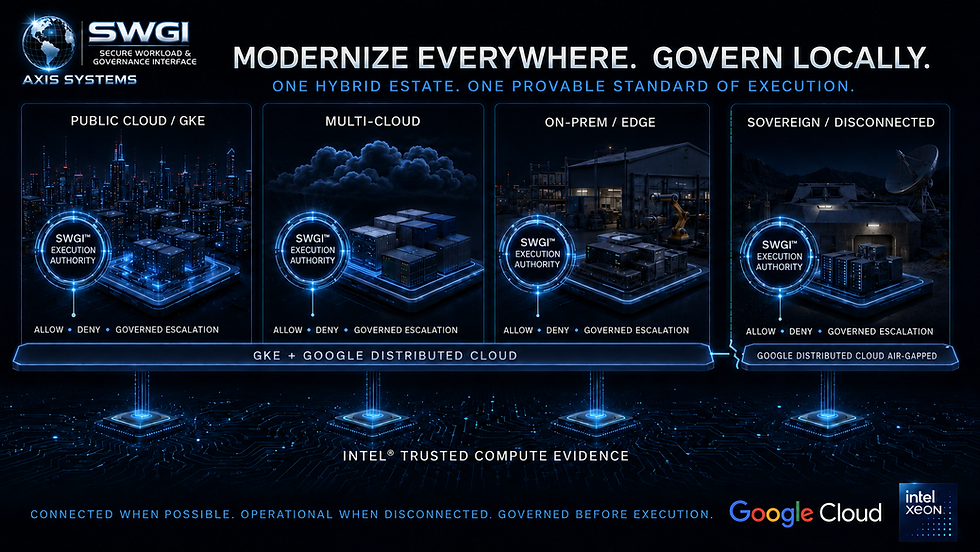
Relevant environments include Google Cloud, Google Kubernetes Engine, Anthos, Kubernetes clusters, hybrid cloud, sovereign deployments, edge environments, and customer-controlled infrastructure.
Confidential Computing and Hardware-Aligned Infrastructure
SWGI™ is designed to align with trusted hardware foundations and confidential-compute environments, including Intel® Confidential Computing, Intel® SGX, Intel® TDX, TPM-based attestation, and hardware-rooted execution assurance.
The purpose is not to replace hardware trust. The purpose is to strengthen the execution-governance layer around sensitive workloads by validating authority before execution and generating proof after authorization.
Customer-Controlled Architecture
SWGI™ is designed to operate within customer-managed infrastructure.
The customer preserves ownership of infrastructure, workloads, data, policy controls, and operational boundaries. SWGI™ focuses on execution governance, authority validation, policy enforcement, and proof generation without requiring sensitive workload data to leave the customer-controlled environment.
This supports tenant isolation, regulated infrastructure, confidential computing, sovereign cloud, hybrid deployment, and high-assurance operational models.
Trust Receipts™ and Immutable Auditability
Every authorized action governed by SWGI™ can generate a cryptographically verifiable Trust Receipt™.
A traditional log says:
Something happened.
A Trust Receipt™ says:
This execution was authorized before it happened.
That distinction is critical.
Trust Receipts™ create cryptographic evidence that execution was policy-cleared, authority-validated, and accountable at the point of action.
This supports policy traceability, authority validation records, immutable audit evidence, compliance evidence workflows, denied-execution records, operational review, infrastructure governance, and customer-controlled audit trails.
This transforms auditability from after-the-fact reconstruction into execution-level proof.
Compliance Evidence and Control Mapping
SWGI™ is not positioned as a generic compliance dashboard.
It is an execution-governance layer that can generate evidence mapped to regulated control environments.
SWGI™ supports alignment with control and assurance areas such as NIST SP 800-53, NIST SP 800-207 Zero Trust Architecture, CIS Controls v8, CMMC 2.0, FISMA evidence readiness, FIPS 140-3 cryptographic alignment, NIST AI RMF, NIST AI 600-1, FedRAMP evidence workflows, SOC 2 control alignment, public-sector procurement evidence, and regulated cloud governance.
The key value is not simply saying a system is secure.
The value is generating machine-verifiable evidence that execution was governed before compute was consumed.
Infrastructure Optimization and Green Compute
SWGI™ is not only a security and compliance layer.
It is also an infrastructure-efficiency layer.
By preventing unauthorized, redundant, abandoned, misconfigured, idle, unnecessary, or policy-violating execution before compute resources are consumed, SWGI™ can help reduce waste across the infrastructure stack.
This is where ghost compute recovery becomes central.
Ghost compute refers to workload activity that consumes compute, memory, storage, network, telemetry, cooling, and operational resources without producing proportional value.
This can include unauthorized workloads, idle execution paths, duplicative jobs, abandoned processes, misconfigured automation, policy-violating workloads, over-permissioned execution, redundant inference calls, unnecessary background processes, and improperly scoped test environments.
When an avoidable execution is denied before it runs, organizations can recover usable compute and memory capacity inside existing infrastructure.
That recovered capacity can be redirected toward higher-value workloads such as advanced analytics, AI services, secure cloud operations, mission-critical applications, and digital modernization programs.
Preventing unnecessary execution can reduce wasted processor cycles, unnecessary cloud consumption, telemetry overhead, logging burden, monitoring cost, cooling demand, power draw, heat generation, operational drag, and infrastructure expansion pressure.
Prevent unnecessary execution before it becomes future infrastructure pressure.
Governance for Autonomous Systems
SWGI™ also provides a governance foundation for autonomous and machine-driven environments.
AI agents, robotic systems, autonomous workflows, industrial automation, and machine-executed actions increasingly operate beyond traditional human-speed review.
These systems need execution authority, not only monitoring.
SWGI™ is relevant to AI agents, agentic workflows, model tool calls, robotic actions, autonomous mobile robots, humanoid systems, clinical automation, industrial automation, infrastructure operations, machine-state transitions, and mission-critical execution paths.
For these systems, the key question is not only whether the system is intelligent.
The question is whether the system is authorized to act.
SWGI™ provides a framework for validating authority before machine-driven execution proceeds.
SWGI™ Use Cases

SWGI™ Use Cases
SWGI™ is designed for environments where execution must be governed before risk, waste, or state change occurs.
Autonomous Robotics and Industrial Systems
SWGI™ can help prevent compromised, injected, or unauthorized AI logic from triggering unsafe physical movement, robotic actions, machine-state changes, or industrial automation events.
Smart Power Grids and Critical Infrastructure
SWGI™ applies deterministic execution governance to grid, utility, and critical infrastructure operations to reduce unauthorized commands, cascading failure risk, and uncontrolled state changes.
Operational Technology and IT Convergence
SWGI™ supports safer coexistence between AI-driven, cloud-connected, or untrusted workloads and legacy industrial control systems, including PLC, SCADA, sensor, and edge environments.
Sovereign and Regulated AI Workloads
SWGI™ delivers deterministic enforcement, customer-controlled governance, and cryptographic Trust Receipts™ for high-assurance, sovereign, defense-aligned, and regulated AI deployments.
Confidential Computing and Trusted Infrastructure
SWGI™ strengthens confidential-compute environments by validating authority before sensitive workloads execute, supporting hardware-rooted attestation, trusted execution environments, and audit-ready proof.
Kubernetes, GKE, and Cloud-Native Workloads
SWGI™ governs containerized workloads, microservices, service mesh activity, API calls, and privileged operations before execution across Kubernetes, Google Kubernetes Engine, Anthos, and hybrid cloud environments.
Zero Trust Execution Governance
SWGI™ extends Zero Trust beyond identity, access, and network controls by enforcing whether workloads, agents, services, and infrastructure actions are authorized to execute at all.
Data Center Efficiency and Ghost Compute Recovery
SWGI™ reduces unauthorized, idle, duplicative, abandoned, misconfigured, or policy-violating execution before compute is consumed, supporting capacity recovery, reduced cloud waste, lower telemetry overhead, and Green Compute efficiency.
Target Environments
SWGI™ is designed for high-assurance and regulated environments where deterministic enforcement is an operational requirement.
Target environments include sovereign AI deployments, data center optimization and Green Compute initiatives, government and public sector, defense and national security, financial services, critical infrastructure, healthcare, energy and utilities, enterprise AI governance, hybrid and multi-cloud environments, autonomous systems, confidential computing environments, Kubernetes-native infrastructure, edge deployments, and mission-critical workloads.
Market Positioning
Axis Systems targets environments where execution accountability, compliance evidence, operational efficiency, and infrastructure control are mandatory.
For public-sector organizations, SWGI™ supports sovereign AI, confidential computing, Zero Trust modernization, Green Compute, and mission-critical infrastructure initiatives requiring deterministic enforcement and verifiable governance.
For commercial organizations, SWGI™ provides a foundation for governing AI systems, autonomous agents, cloud-native applications, distributed workloads, and privileged operations while improving operational efficiency and infrastructure accountability.
SWGI™ is designed to support procurement and deployment pathways through Google Cloud Marketplace, public-sector channel alignment through Carahsoft, and trusted-infrastructure positioning through Intel-aligned confidential computing environments.
Key Outcomes
SWGI™ delivers value across security, compliance, operational efficiency, and infrastructure economics.
Key outcomes include:
Operational accountability through Trust Receipts™Compliance evidence mapped to governance frameworks, Zero Trust execution governance beyond access control Ghost compute recovery before waste occurs Capacity recovery inside existing infrastructure Reduced telemetry, cloud, power, cooling, and operational waste Improved effective compute utilizationHigh-assurance deployment for governed, validated, and proven execution
Conclusion
The future of infrastructure will not be defined only by how much compute organizations can deploy.
It will be defined by how much execution they can govern.
Unauthorized execution creates risk.
Unnecessary execution creates waste.
Unproven execution creates audit exposure.
Misclassified demand creates infrastructure pressure.
SWGI™ addresses this at the execution boundary.
It validates authority before compute is consumed, generates Trust Receipts™ after authorization, strengthens compliance evidence, reduces avoidable execution, improves infrastructure efficiency, and helps organizations separate legitimate workload demand from waste.
Axis Systems is building deterministic execution infrastructure for the AI era.
The most secure workload is not only the one that is monitored.
It is the one that was authorized before it was executed.

Comments