Deterministic Governance for Sovereign AI Execution and Cloud Infrastructure
Updated: Jul 2
Artificial intelligence is rapidly becoming a foundational layer of modern infrastructure. From critical infrastructure and public-sector environments to enterprise cloud platforms and autonomous systems, organizations are increasingly relying on AI to make decisions, process sensitive information, and execute workloads at scale.
Yet most infrastructure still operates on a fundamentally reactive model.
Workloads execute first.
Governance happens later.
Logs are reviewed after the fact.
Alerts are generated after resources have already been consumed.
As AI systems become increasingly autonomous, this gap between execution and governance becomes more difficult to secure, audit, and control.
The next evolution of infrastructure is not simply more intelligence.
It is governance at the point of execution.
Why Deterministic Governance Matters for Sovereign AI Infrastructure
Sovereign AI is about more than data residency.
It is about maintaining control over how AI workloads execute, who authorized them, what infrastructure they consume, and whether execution can be independently verified.
Organizations operating in regulated environments, critical infrastructure, defense systems, and enterprise AI platforms must be able to answer fundamental questions:
Who authorized execution?
What policy approved the action?
What infrastructure executed the workload?
Was the execution compliant with governance requirements?
Can the decision be independently verified?
Without governance at the execution layer, these answers often require reconstruction after the event.
Deterministic Governance introduces a model where authority is validated before execution occurs.
The Shift from Monitoring to Deterministic Governance
Traditional security and governance platforms focus primarily on observation.
They monitor execution.
They inspect logs.
They generate alerts.
They identify anomalies.
While these capabilities remain important, they all share a common limitation:
The workload has already been executed.
The computing resources have already been consumed.
The action has already occurred.
Deterministic Governance introduces a fundamentally different approach.
Instead of governing workloads after execution, governance occurs before execution.
Before a workload is permitted to consume compute resources, the system evaluates authority, policy, context, identity, compliance requirements, and execution conditions.
If authorization requirements are satisfied, execution proceeds.
If authorization requirements are not satisfied, execution does not occur.
Execution becomes an authorized event rather than an assumed event.
Introducing SWGI™
SWGI™ (Secure Workload Governance Interface) is Axis Systems' deterministic governance framework designed to bring authorization directly into the execution pathway.
SWGI™ introduces pre-execution authorization that validates workload authority before compute resources are consumed.
Rather than relying exclusively on monitoring and remediation, SWGI™ establishes a governance checkpoint before execution occurs.
This enables organizations to:
Deterministic Governance
Pre-Execution Authorization
Sub-Millisecond Authorization
Compute Efficiency
Confidential Computing
Runtime Governance
Trust Receipts™
Compliance Framework Alignment
Audit-Ready Infrastructure
Policy Enforcement
Zero Trust at Execution
Sovereign AI Controls
The model is simple:
Authorize → Execute → Prove

Deterministic Governance for Sovereign AI Infrastructure showing SWGI™, pre-execution authorization, Intel Xeon foundation, Google Cloud orchestration, Trust Receipts™, sub-millisecond authorization, and compute efficiency.
Compliance by Design, Not After the Fact
Modern compliance frameworks increasingly require organizations to demonstrate not only what occurred, but also who authorized it, why it was permitted, and whether execution complied with established policy.
Traditional compliance models often depend on logs, screenshots, manual reviews, and post-event reconstruction.
Deterministic Governance changes that model.
By introducing authorization before execution, organizations gain the ability to enforce policy directly within the execution pathway rather than relying exclusively on post-execution controls.
SWGI™ helps strengthen alignment with governance and compliance initiatives, including:
NIST Cybersecurity Framework (CSF)
NIST SP 800-53
FedRAMP
CMMC
SOC 2
ISO 27001
Zero Trust initiatives
Internal governance and audit programs
Trust Receipts™ provide cryptographically verifiable evidence of authorization decisions, policy outcomes, and execution activity, creating an audit-ready foundation for regulated and high-assurance environments.
Instead of asking what happened after execution, organizations gain the ability to demonstrate why execution was authorized in the first place.
Pre-Execution Authorization and Runtime Governance
Security controls are often viewed as operational friction.
Execution governance should not be.
SWGI™ is designed around sub-millisecond authorization workflows that enable governance decisions to occur before execution while maintaining operational performance.
Pre-execution authorization validates workload authority before execution begins.
Runtime governance provides continuous visibility into authorized workload behavior after execution occurs.
Together, these capabilities create a governance model that provides both preventative control and operational transparency.
Organizations gain real-time control over workload activity while maintaining visibility into execution outcomes.
Compute Efficiency Through Deterministic Governance
One of the most overlooked challenges in modern infrastructure is unnecessary compute consumption.
Unauthorized workloads.
Misconfigured workloads.
Idle workloads.
Uncontrolled workload execution.
All consume resources regardless of whether they create business value.
When governance occurs after execution, compute resources have already been consumed.
When governance occurs before execution, unnecessary workload activity can be prevented before resources are allocated.
This creates a powerful secondary benefit:
Compute Efficiency.
By reducing unauthorized and unnecessary execution paths, organizations can improve infrastructure utilization, reduce waste, strengthen operational control, and increase overall efficiency across AI and cloud environments.
Trust Receipts™, Auditability, and Compliance Evidence
Every governance decision should be explainable.
Every execution event should be auditable.
Every authorization outcome should be verifiable.
SWGI™ generates cryptographically verifiable Trust Receipts™ that create a persistent record of authorized execution activity.
These records provide visibility into:
Authorization Decisions
Policy Outcomes
Execution Events
Governance Actions
Compliance Evidence
Audit Readiness
Trust Receipts™ provide a verifiable record of execution decisions that can support compliance reporting, governance reviews, internal audits, and regulatory evidence requirements.
Trust Receipts™ transform governance from a monitoring exercise into a verifiable system of record.
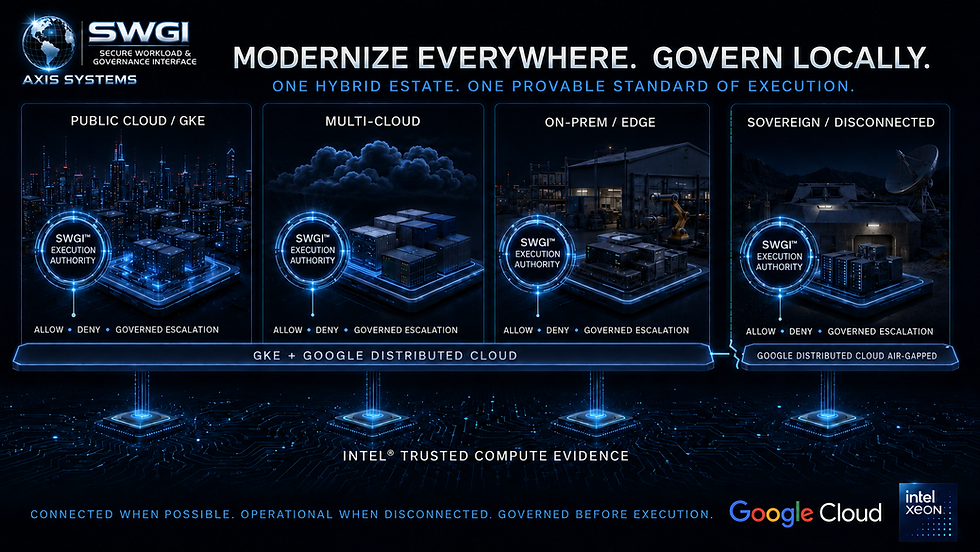
Deterministic Governance for Sovereign AI Infrastructure Across Intel® Xeon® 6 and Google Cloud
Modern AI infrastructure spans cloud, hybrid, sovereign, and edge environments.
SWGI™ is designed to operate across modern infrastructure stacks, including Intel® Xeon® 6 and Google Cloud technologies such as Anthos and Google Kubernetes Engine (GKE).
This enables organizations to combine:
Deterministic Governance
Confidential Computing
Pre-Execution Authorization
Runtime Governance
Compute Efficiency
Sovereign AI Controls
Compliance Framework Alignment
Audit-Ready Trust Receipts™
Zero Trust at Execution
The architecture below illustrates how SWGI™ integrates governance directly into the execution pathway.
By combining Intel® hardware-rooted security technologies with Google Cloud orchestration platforms such as Anthos and GKE, organizations can establish deterministic authorization, confidential execution environments, cryptographic Trust Receipts™, and compute-efficient workload governance across sovereign and regulated infrastructures.

Deterministic Governance for Sovereign AI Infrastructure across Intel® Xeon® 6 and Google Cloud Anthos & GKE, showing confidential computing, workload authorization, Zero Trust at execution, Trust Receipts™, and compute efficiency.
The Future of Sovereign AI Infrastructure
The future of infrastructure is not simply faster computing.
It is not simply larger AI models.
It is not simply more automation.
The future of infrastructure is deterministic governance.
Organizations need the ability to determine whether execution should occur before resources are consumed.
They need visibility into authorization decisions.
They need verifiable proof of execution.
They need infrastructure that is secure, efficient, compliant, and accountable by design.
Through SWGI™, Axis Systems is advancing a new model for cloud, AI, and critical infrastructure environments - one where workloads are authorized before they execute, governance becomes verifiable, compliance becomes auditable, and organizations gain greater control over the systems they depend upon.
Authorize → Execute → Prove.

Comments