Governing the Agentic Internet - Identity, Authority, Execution, & Proof for Autonomous Systems Operating across the Open Internet

The internet was built to move information - The open agentic internet will move decisions, authority, capital, and action.
AI agents are beginning to operate beyond closed applications and controlled enterprise environments - They are calling APIs, using tools, modifying software, initiating transactions, coordinating with other agents, and interacting with systems owned by organizations other than the one that created them.
That transition changes the nature of the internet.
An agent is not simply another user retrieving information. It is a software actor capable of producing real operational consequences.
That makes identity essential - but identity alone cannot establish trust.
A trustworthy agentic internet will require a complete operating stack:
Identity. Delegated authority. Execution governance. Verification. Proof.
These layers must work together.
From an information network to an action network
Traditional internet infrastructure was designed primarily to move packets, resolve names, establish connections, and deliver information.
AI agents introduce something different.
They can:
write and deploy code
call external services
purchase products and services
access enterprise data
modify cloud infrastructure
initiate financial workflows
perform cybersecurity actions
operate robotics and autonomous systems
interact with public-sector and critical infrastructure environments
Once an agent can act, the central question is no longer only whether it can connect.
The system must determine:
Who is the agent?
Which organization is accountable for it?
Where did its authority originate?
What actions has it been permitted to perform?
Does that authority apply to the current target and context?
Should this specific action be allowed to proceed?
Can the decision be verified afterward?
This is the emerging control problem of the agentic internet.
Identity is the beginning of trust
Open-agent infrastructure needs a consistent way to establish who an agent represents.
Emerging DNS-linked identity and registration models provide an important foundation. They can associate an agent with an accountable internet domain, the organizational owner, registration history, and cryptographically verifiable identity.
This gives platforms and other agents a reliable starting point:
The agent can identify itself
An accountable organization can be established
Its identity history can be reviewed
Cryptographic proof can strengthen trust
Independent systems can use a common identity framework
That is necessary infrastructure.
But a valid identity is not unlimited authority.
A verified employee is not automatically authorized to transfer company funds.
A registered vehicle is not automatically permitted to enter every restricted area.
A properly authenticated administrator is not automatically approved to change every production system.
The same principle applies to AI agents.
Agent identity tells us who is acting.
Execution governance determines whether the action should be allowed to proceed.
Authority must be delegated and contextual
AI-agent authority cannot be treated as a permanent blanket permission.
An agent may be allowed to read a dataset but not modify it.
It may be allowed to propose a transaction but not to authorize settlement.
It may be allowed to identify a vulnerability but not to alter production infrastructure.
It may be allowed to call one API, operate for one user, perform one workflow, or act within one time window - but nothing beyond those limits.
Authority, therefore, must be:
explicitly delegated
scoped to an actor and action
tied to policy
limited by time and context
revocable
independently verifiable
The system must evaluate more than a credential.
It must understand the requested action, the actual target, the policy governing the request, the environment state, and the source and limits of the agent’s authority.
This is where identity becomes operational trust.
The governance stack for the Agentic Internet

A safe autonomous internet requires both established infrastructure and new governance layers.
Layer 1 - High-Assurance Silicon
Physical processors, accelerators, trusted execution environments, confidential memory, and hardware roots of trust form the execution foundation.
This is where authorized computation ultimately occurs.
Layer 2 - Platform Orchestration
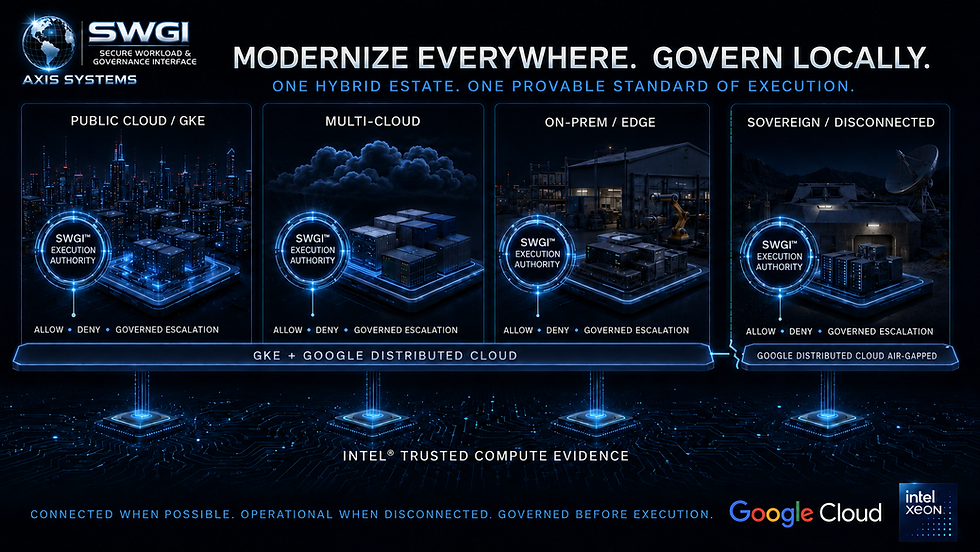
Cloud platforms, Kubernetes, GKE, OpenShift, containers, schedulers, and workload-management systems allocate and operate computing resources.
These platforms determine how workloads execute once permission has been granted.
Layer 3 - Verification and Provenance
The verification layer records authorization history, cryptographic evidence, workload provenance, and governed outcomes.
Trust Receipts™ create verifiable evidence of what was requested, which policy applied, and why an action was allowed or denied.
Layer 4 - Execution Control Loop
The execution-control layer evaluates intent, identity, delegated authority, policy, target, context, and environmental conditions.
It makes a deterministic decision before the state advances:
Allow or deny.
Layer 5 - Autonomous Logic Gate
The autonomous logic gate intercepts agent instructions, API requests, tool calls, workloads, and privileged actions at the perimeter before execution begins.
It is the first governance boundary between agent intent and operational consequence.
These layers form the Axis execution-governance architecture.
Where agent identity fits
Agent identity and registration should not be forced into one of the numbered execution layers.
It operates upstream as a trusted input.
The identity layer establishes:
Who the agent is
Which organization is accountable for it
Where the identity originated
Whether the identity can be cryptographically trusted
Whether the registration remains valid
That identity evidence then enters the execution-governance stack:
Identity evidence → autonomous interception → authority decision → verification and Trust Receipt → orchestration → hardware execution
This is the complete architecture.
Identity infrastructure establishes the actor.
Axis evaluates the requested action.
SWGI™ determines whether execution may proceed.
Trust Receipts™ preserve proof.
Existing cloud and hardware infrastructure performs the authorized work.
Governing Systems of Consequence
The purpose of this architecture is not to govern every harmless interaction across the internet.
It is to govern execution in which autonomous actions can create material operational, financial, legal, safety, or national security consequences.
Axis defines these environments as systems of consequence.
They include:
cloud platforms, APIs, and distributed services
internet infrastructure, DNS, registries, CDNs, and edge networks
enterprise applications and core business systems
financial systems, payment rails, and transaction platforms
government, defense, and public-sector environments
healthcare platforms and regulated data systems
software-development pipelines and code-deployment environments
robotics, autonomous machines, and cyber-physical systems
critical infrastructure and essential public services
identity, access, credential, and trust-management systems
industrial operations, manufacturing, and control systems
privileged administrative and remediation workflows
telecommunications and network service providers
digital marketplaces and cross-platform commerce systems
data platforms, SaaS ecosystems, and machine-to-machine services
The open internet becomes a governance problem when an agent moves from communication into action.
An agent may identify itself, exchange information, negotiate with another system, or request access without creating immediate consequences.
The control requirement changes when that agent attempts to:
modify data
invoke an API
deploy code
move money
change infrastructure
trigger a workflow
access to a protected resource
alter permissions
control a machine
initiate a regulated or mission-sensitive action
At that point, identity alone is insufficient.
The system must determine whether the agent possesses valid delegated authority, whether the requested action is permitted under current policy and context, and whether execution should be allowed to proceed.
The point of control is therefore not the entire internet - It is the boundary at which an autonomous agent attempts to touch a consequential system.
Axis governs execution at the points where agents touch systems of consequence.
Trust Receipts™ create durable accountability
Real-time authorization is only one part of trusted agent activity.
Organizations will also need proof.
After an action is evaluated, stakeholders may need to establish:
Which agent made the request
Which organization was accountable for the agent
Where its authority originated
What action was attempted
Which target is it attempting to reach
What policy governed the decision
Whether the request was allowed or denied
When the decision occurred
Whether the evidence has been modified
Trust Receipts™ provide the evidence layer.
They preserve governed decisions as signed, tamper-evident records that can support:
audits
regulatory review
incident response
contractual accountability
insurance
dispute resolution
procurement
cross-platform agent trust
public-sector oversight
An autonomous economy cannot depend solely on statements that an agent was “trusted.”
It needs verifiable evidence of what the agent was authorized to do.
The infrastructure moat of the agentic economy
The most visible companies in the agentic economy may be the ones building the smartest models and agents.
The most durable companies may be the ones establishing the infrastructure that makes those agents safe enough to use.
As autonomous agents move across organizations, the strategic control points will include:
identity registration
delegated authority
execution authorization
policy enforcement
evidence generation
verification
revocation
accountability
These capabilities will become embedded across cloud platforms, agent identity and registry systems, SaaS ecosystems, API gateways, cybersecurity products, financial networks, payment rails, internet infrastructure, telecommunications networks, digital marketplaces, data platforms, public-sector environments, and critical infrastructure.
A collaborative architecture, not a single-vendor answer
No single company should be expected to own every layer of the agentic internet.
Identity providers should establish accountable actors.
Cloud and orchestration platforms should provide scalable execution environments.
Hardware providers should deliver trusted computing foundations.
Cybersecurity platforms should identify risk and exposure.
Execution-governance systems should determine whether sensitive actions may proceed, with Evidence preserved.
The architecture becomes stronger when these layers integrate.
What comes next
The agentic internet will require standards that allow authority and trust to move across organizational boundaries.
Future infrastructure will need to support:
portable agent identity
cryptographically verifiable registration
delegated and revocable authority
policy-bound actions
contextual execution decisions
target verification
cross-platform enforcement
signed evidence
independent receipt verification
accountable autonomous transactions
The internet became commercially useful because common protocols allowed different systems to communicate.
The agentic internet will become operationally trustworthy when common trust layers allow different systems to determine whether agents are authorized to act with cryptographic proof.
The next major internet control layer
The agentic internet will not be governed by identity alone.
It will not be governed by monitoring after execution.
It will not be governed by static permissions that ignore context, changing conditions, and the real target of an action.
It will require a complete trust architecture:
Identity to establish the actor.
Delegated authority to define what is permitted.
Execution governance decides whether the action should proceed.
Verification and Trust Receipts™ to preserve proof.
Cloud and hardware infrastructure to perform the authorized work.
The next generation of the internet will not only connect intelligent systems.
It will need to govern what those systems are allowed to do.
Axis governs execution at the points where agents touch systems of consequence.

Comments